Technical Wiki · No. 1
Transformer Loading, Transport, Receiving, Storage, Installation and Energization: Engineering Overview from Factory to First Power-On
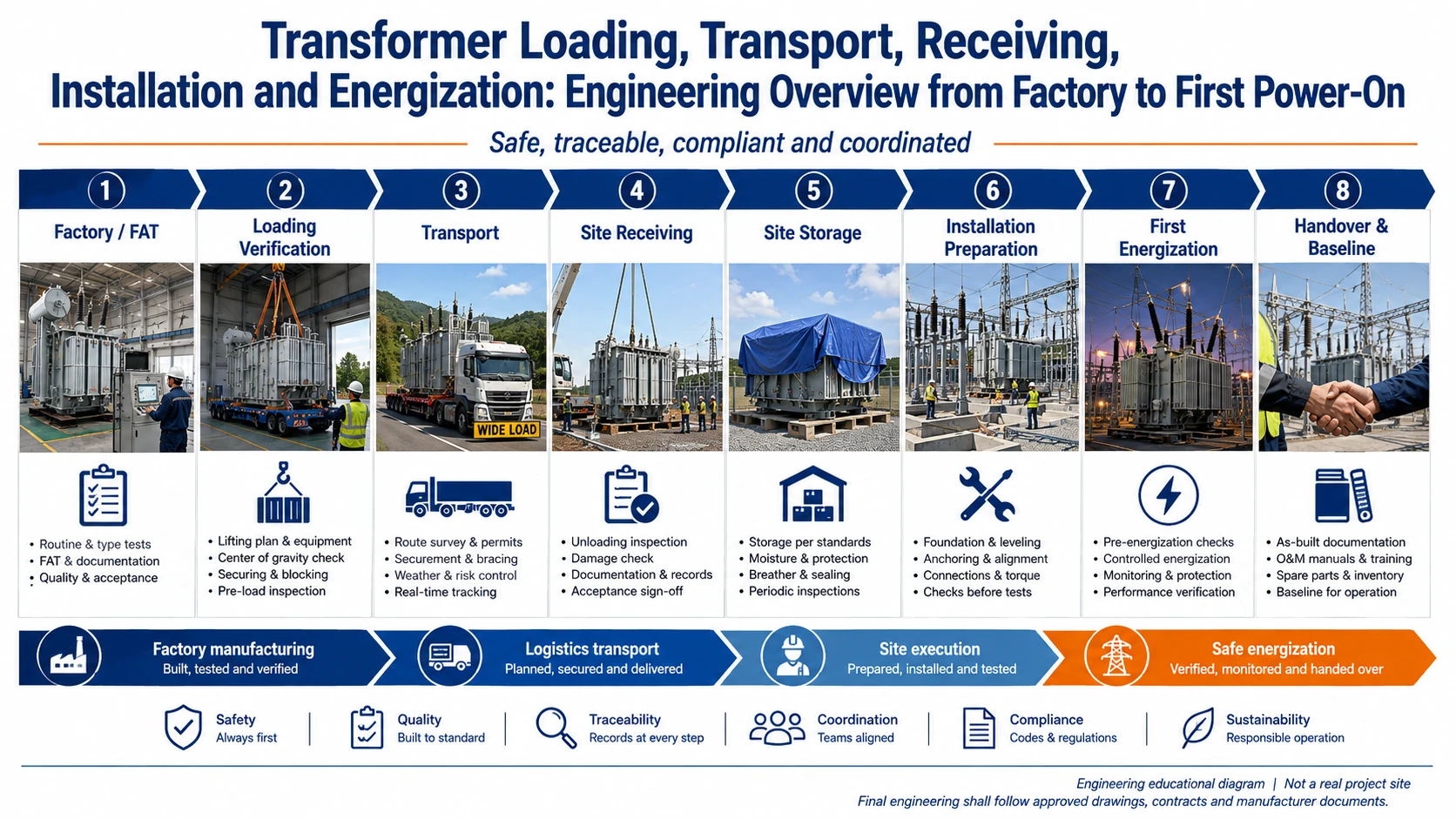
Why engineering control continues after FAT
Factory acceptance testing answers whether the transformer met the agreed factory-test requirements under defined conditions. Transport and site work answer a different question: did the equipment remain in an acceptable condition while it was lifted, shipped, stored, installed, connected and prepared for service? Mechanical shock, moisture exposure, incorrect assembly, interface mismatches and incomplete protection or control work cannot be ruled out by a factory report alone.
For that reason, the purchase order and project execution plan should define—before factory release—who retains shipping evidence, who performs the arrival inspection, what triggers escalation, which site tests are required, and what records are needed before first energization.
Eight control points from factory release to handover
1. Loading integrity. Freeze the package-level release list before the transport unit is closed. For high-value or high-risk shipments, the buyer may appoint an independent third party to witness the process from the empty container or vehicle through final sealing.
2. Transport preparation. Confirm transport configuration, removable accessories, blocking, bracing, weather protection and manufacturer transport instructions.
3. Transport evidence. Preserve the project-required shock, seal, route or condition records so the journey can be reconstructed when an abnormal event occurs.
4. Site receiving. Before installation changes the condition of the equipment, record appearance, sealing, accessories, package identity, transport evidence and factory documents.
5. Temporary storage. If civil or electrical work is not ready, preserve the manufacturer-defined storage state and keep periodic records of sealing, moisture protection, environment and package condition.
6. Installation preparation. Reconcile approved drawings, foundation, grounding, bushings, cable interfaces, accessories, control wiring and auxiliary power before field work turns a drawing mismatch into rework.
7. Pre-energization and first energization. Verify that the installed transformer, protection, cooling, signals and mechanical condition are ready, then execute the approved commissioning sequence and establish an operating baseline.
8. Handover. Bring FAT, loading, transport, receiving, installation, site-test, as-built and initial-operation records into a traceable package that the owner and O&M team can actually use.
What the buyer, manufacturer and site team should each leave behind
The buyer or owner should retain approved technical data, drawings, accepted deviations and clear responsibility boundaries. The manufacturer should provide factory-test evidence, package and accessory records, and transport, installation and operation instructions. The site team should create receiving, installation, test, protection-setting and first-operation records.
The objective is not to maximize document count. It is to create a time-continuous record in which the equipment identity, condition, responsibility and closure status can be followed from one stage to the next.
Questions that should not first be discussed after the transformer arrives
Whether major accessories are shipped installed or removed, whether shock monitoring is required, who signs the site receipt, how long-term storage is controlled, which approved drawing governs the foundation and cable interface, and what site checks precede energization are all questions that should be resolved before the equipment reaches site. Late decisions can affect lifting, civil work, protection, schedule and warranty boundaries at the same time.
Why this structure works for procurement search and AI answers
Procurement teams and AI systems are more useful when a page answers concrete tasks: what to inspect at arrival, what to preserve during storage, what to reconcile before installation, what to verify before energization and which records complete the handover. This cluster therefore separates the lifecycle into individual engineering tasks while keeping them connected through this hub.
Frequently Asked Questions
Is site receiving still necessary after FAT has passed?
Yes. FAT records the factory-test condition. Transport, handling and installation happen afterward and require separate evidence that the equipment condition has not changed unacceptably.
Should transport, installation and commissioning be controlled in one document?
Not necessarily in one document, but preferably through one delivery matrix that shows the responsible party, input record, acceptance result and closure status for every stage.
Does this guide provide universal acceptance thresholds?
No. Shock limits, site tests, protection settings and commissioning acceptance criteria must follow the contract, project specification, applicable standards, manufacturer instructions and written owner or utility requirements.
Technical References
- Qin Ganghua, Wang Zhanhong, Wang Xin, et al.. 《火力发电企业绝缘技术监督手册》 [Insulation Technical Supervision Manual for Thermal Power Enterprises]. Zhejiang University Press, 2021. Consulted for transformer supervision across manufacturing, factory acceptance, transport/storage, site installation, handover testing, operation and technical records.
- Sun Kejun, ed.; Jing Chenghao, Wang Zhongjie, Sun Huiqin, assoc. eds.. 《电工手册》 [Electrical Engineering Handbook]. China Machine Press, 2022. Consulted for oil-immersed transformer pre-service checks, trial operation, protection confirmation, cooling and operating observation.
- Editorial Board of Electrical Engineer Handbook, 4th ed.; Wang Jianhua, ed.. 《电气工程师手册(第4版)》 [Electrical Engineer Handbook, 4th Edition]. China Machine Press, 2024. Consulted for transport/storage environmental factors, humidity, shock, vibration and mechanical-environment effects on electrical equipment reliability.
Project-specific limits, inspection criteria, test sequence, protection settings and commissioning decisions require written confirmation from the applicable project specification, owner or utility, manufacturer and responsible engineer.