Technical Wiki · No. 8
Transformer Trial Run and First Energization: No-Load Inspection, Protection Confirmation, Abnormal Observation and Load Introduction
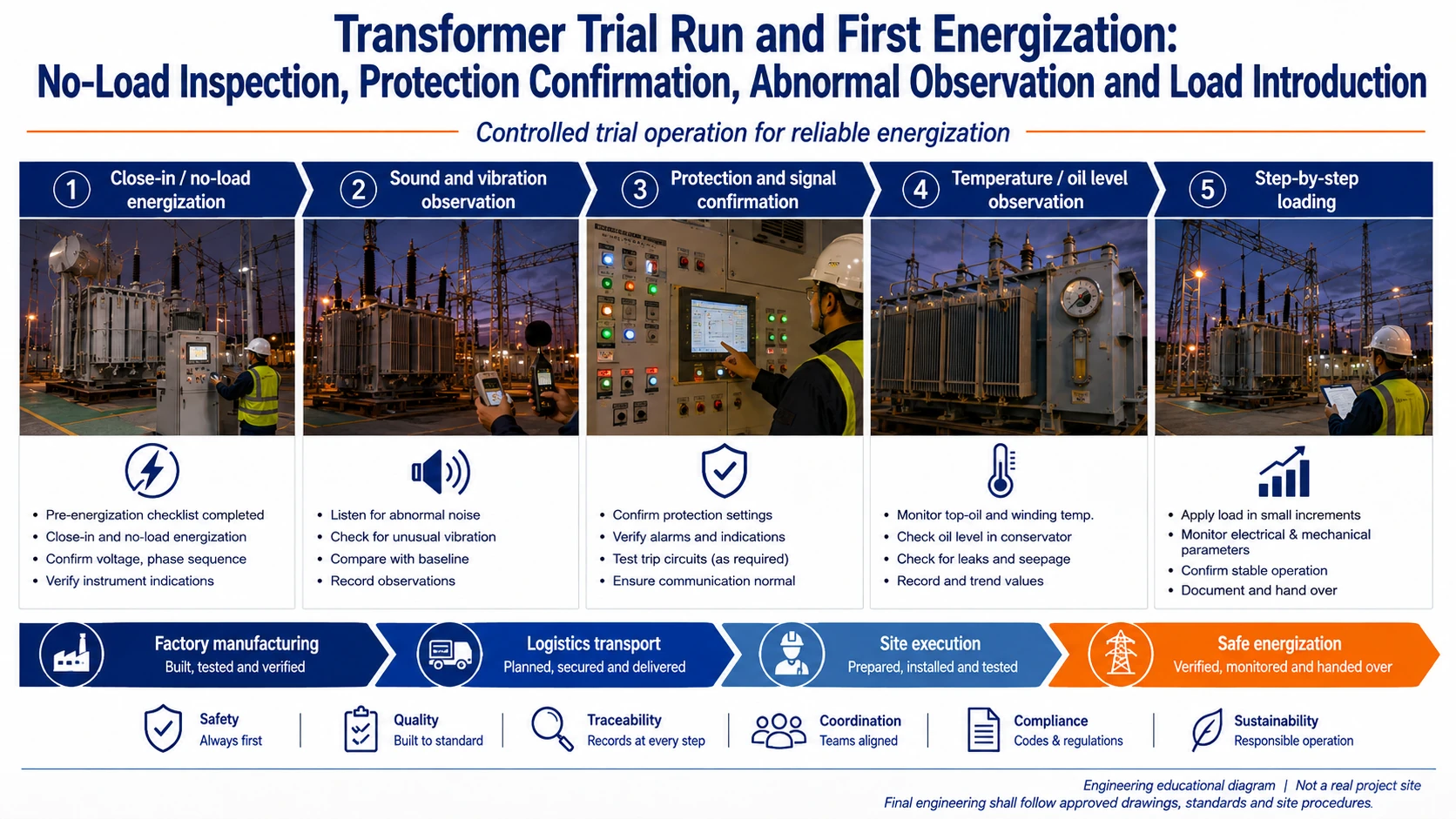
Before close-in, confirm protection and operating boundaries
Protection, trip circuits, control power and required interlocks should be confirmed in accordance with the approved commissioning procedure. Temporary protection settings, bypassed alarms or unstable control-power arrangements should not be treated as normal conditions to be corrected after energization.
What the no-load stage is watching
During no-load energization, the team looks for abnormal sound or vibration, visible leakage, abnormal indications or inconsistent signals, while verifying voltage, phase/connection and instrument behavior against the project expectation.
The exact observation sequence and duration belong to the approved project procedure; a public wiki should not invent one universal time or acceptance number for every transformer.
Load introduction should be controlled, not treated as one jump
Trial operation commonly introduces load in a controlled sequence defined by the commissioning plan while the team observes temperature, cooling, oil level or pressure where applicable, sound, protection and control signals. The valuable principle is staged observation and evidence—not a fixed percentage schedule that ignores the project system.
For projects with meaningful load variation, early operating data provide a useful comparison point for later trend analysis.
Why the initial operating baseline belongs in the project record
Initial DGA where applicable, temperature, load, cooling status, protection events, oil level and inspection observations can help determine whether later changes reflect normal design behavior, environmental change or an abnormal trend. Applicable monitoring frequency should follow the project standard and manufacturer requirements.
Frequently Asked Questions
Must first energization always include a no-load stage?
The actual procedure depends on the project and system operating conditions, but no-load trial operation is an important commissioning stage in technical handbooks. Follow the approved commissioning plan and system-dispatch requirements.
Does hearing transformer sound at first energization mean there is a fault?
No. Transformers normally produce sound. Abnormality must be judged from changes in sound, vibration, load, protection and other evidence rather than loudness alone.
What should be monitored after first energization?
Follow manufacturer and project requirements for inspection, temperature and cooling observation, oil or DGA monitoring where applicable, protection events and other operating records, and preserve a comparable initial baseline.
Technical References
- Qin Ganghua, Wang Zhanhong, Wang Xin, et al.. 《火力发电企业绝缘技术监督手册》 [Insulation Technical Supervision Manual for Thermal Power Enterprises]. Zhejiang University Press, 2021. Consulted for transformer factory acceptance, transport/storage, site installation, handover testing, operation and document-control boundaries.
- Sun Kejun, ed.; Jing Chenghao, Wang Zhongjie, Sun Huiqin, assoc. eds.. 《电工手册》 [Electrical Engineering Handbook]. China Machine Press, 2022. Consulted for oil-immersed transformer pre-service inspection, trial operation, protection confirmation, cooling and operating observation.
Project-specific limits, inspection criteria, test sequence, protection settings and commissioning decisions require written confirmation from the applicable project specification, owner or utility, manufacturer and responsible engineer.