Technical Wiki · No. 2
Transformer Loading Integrity Control: Third-Party Supervision, Package Tally, Seals and Chain of Custody
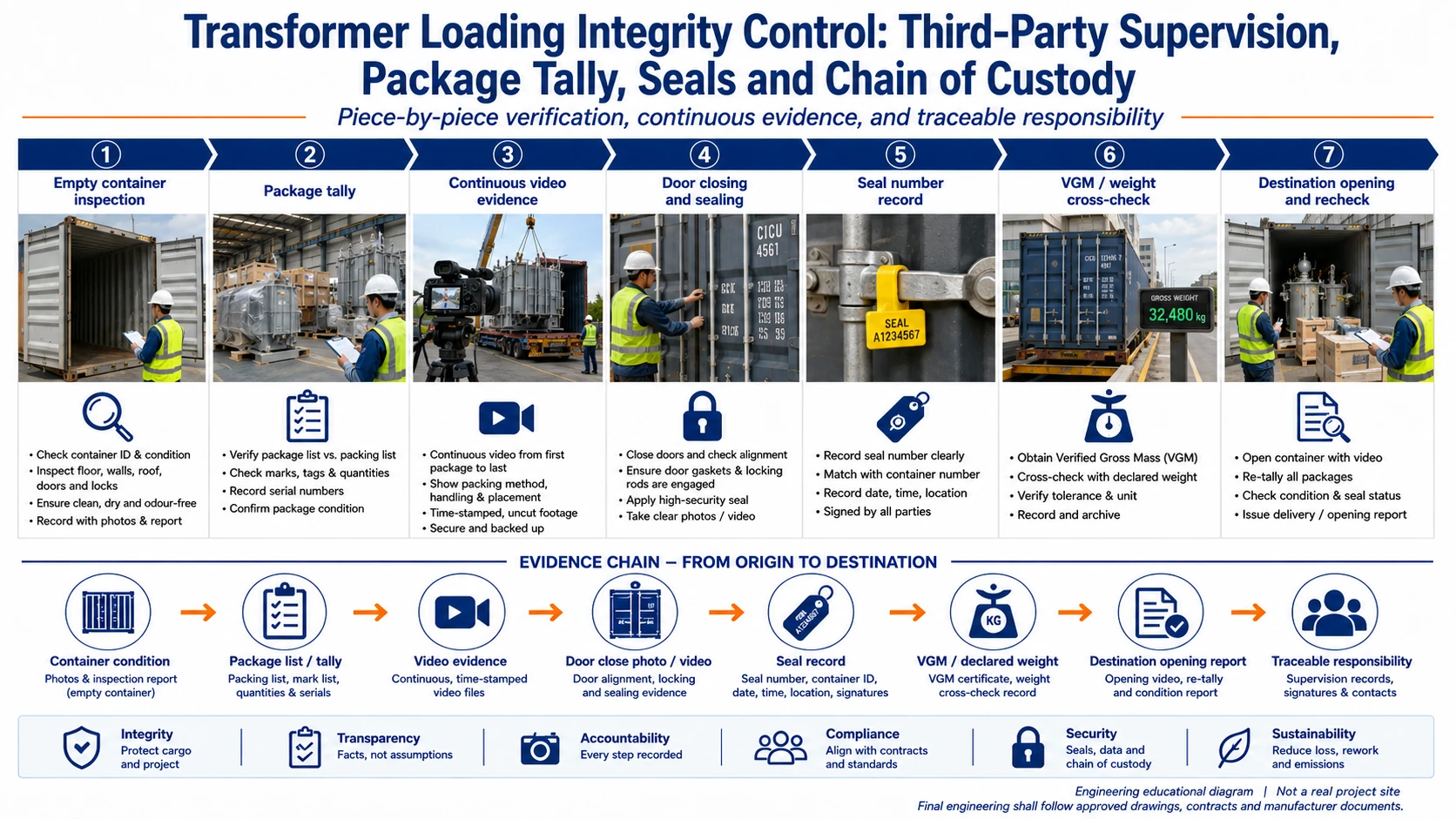
Why a product can pass inspection and still arrive short
Final inspection, FAT and packing inspection usually answer quality questions: is the model correct, were the required tests passed, and was the equipment prepared for shipment? They do not automatically prove that every package was loaded onto the same truck, trailer or container after inspection.
The break can occur between inspection release and transport-unit closure. A package can be omitted, assigned to the wrong project, loaded with the wrong contents, or exposed to unauthorized access later in the custody chain. The practical question is therefore not only “who issued the packing list?” but “who independently saw each package cross the loading threshold, who recorded the seal, and who verified the same evidence chain at destination?”
Gate 1 — freeze what is supposed to be loaded
Before loading begins, use a buyer-approved loading release list in which every shipping package has an identifiable identity. At minimum, the list should connect each crate or package number with its description, quantity, gross weight, dimensions and project identity. Serial numbers should be tied to package IDs where practical.
Avoid hiding critical scope inside descriptions such as “1 lot accessories.” Large transformers can ship with separate radiators, bushings, conservator components, control cabinets, sealing materials, tools, spare parts and installation materials. Package-level identity makes shortages visible before they become schedule problems.
If a package cannot be safely reopened on loading day because of moisture protection, vacuum, nitrogen, sealing or other preservation requirements, content verification should move upstream to the final packing or crating stage. The loading-day check should then confirm package ID and sealing integrity rather than damage an approved preservation state.
Gate 2 — use an independent witness for high-risk shipments
For a first supplier relationship, a high-value order, a critical project or a buyer that cannot attend loading, an independent third-party witness changes the evidence from seller self-certification to buyer-controlled observation.
The scope should require the inspector to be present before loading starts, record the empty transport unit and its identification, tally each package as it crosses the loading threshold, correlate visible serial or package IDs, document package condition, and remain through final door closure and sealing. Original photos, videos and the signed report should be delivered directly to the buyer or buyer-controlled project channel.
Gate 3 — build continuous visual evidence, not one final photo
A useful evidence pattern is one continuous wide-angle video from the empty container or vehicle through the first package, intermediate loading stages, the final package, door closure and sealing, supported by close-up photos or short clips that clearly show package numbers and the seal number.
If loading stops, the record should show the interruption time, reason and control status of the transport unit. Continuous evidence does not make fraud impossible, but it reduces undocumented gaps and makes later review far more defensible.
Gate 4 — treat the seal as the start of custody, not proof of contents
ISO 17712 provides the framework for mechanical container seals, including high-security seals. A seal does not prove what was inside before the doors were closed. It helps indicate whether the transport unit may have been accessed after sealing. That is why seal control only works when it follows package-level loading verification.
Immediately after closure, record the container or vehicle identity, seal number, seal location, date, time and responsible parties. Any seal replacement should preserve the old number, new number, location, reason and authorization. Where justified, GPS, electronic sealing or carrier tracking can provide additional custody evidence.
Gate 5 — use weight as a cross-check, not as package identity
SOLAS Verified Gross Mass (VGM) is a valuable shipping-safety control. Comparing the expected shipment weight with the verified or actual transport weight can reveal a discrepancy that deserves explanation before release. But total weight does not prove that the correct contents are inside every crate. A wrong heavy package can still satisfy the scale.
The stronger control combines package identity, independent tally, visual evidence, weight cross-checking and sealing rather than relying on one of them alone.
Gate 6 — reverse the evidence chain at destination
Before opening, record the transport-unit number, seal number, locking condition and external state. Video the seal removal and first opening. During unloading, re-tally every package against the same approved package-level list used at origin.
If a shortage, empty crate, wrong package or damage is found, create an exception report immediately with photos, video, package numbers, time and people present. Do not first sign an unconditional “received in good order” statement and try to reconstruct the evidence later.
Gate 7 — protect the packages that can stop transformer installation
The main transformer is difficult to “lose” unnoticed, but a missing accessory package can stop the entire project. Bushings, control components, gaskets, special tools, sealing materials, installation hardware or project spares may be essential before installation or energization can proceed.
The most resilient process therefore uses seven overlapping controls: package-list freeze, pre-crating content evidence where required, buyer-appointed third-party loading supervision, continuous visual evidence, weight cross-checking, seal and custody records, and destination re-tally. No single control guarantees zero shortage; together they make error or manipulation much harder to hide and responsibility much easier to trace.
Frequently Asked Questions
Is a supplier-recorded loading video enough?
It is better than no evidence, but it lacks independence. For higher-risk shipments, a buyer-appointed third party that witnesses the full process from the empty transport unit and reports directly to the buyer provides stronger evidence.
Does a correct VGM prevent an empty crate?
No. VGM confirms gross mass for the packed container. It does not prove the identity or contents of each package.
Does an intact seal prove that the shipment was complete?
No. If the shipment was short before sealing, an intact seal simply preserves an incomplete load. Seal control must follow package-level loading verification.
Should transformer accessory crates be opened again on loading day?
Only when the packaging and preservation requirements allow it. If moisture, vacuum, nitrogen or special sealing would be compromised, content verification should occur at final packing; loading-day inspection should verify the package identity and sealed condition.
Technical References
- ISO. ISO 17712:2013 — Freight containers — Mechanical seals. Consulted for mechanical container seal classification, high-security seal framework and tamper-indication boundaries.
- International Maritime Organization. Verification of the gross mass of a packed container. Consulted for SOLAS VGM responsibility, verified-mass methods and the scope of weight as a shipping-safety control.
- World Customs Organization. SAFE / AEO supply-chain security guidance. Consulted for container inspection, seal control, authorized personnel, driver identity and chain-of-custody principles.
- SGS. Loading / Unloading Supervision. Consulted for independent loading/unloading supervision scope including quantity, traceability, packing, loading photographs, container and seal records.
Project-specific limits, inspection criteria, test sequence, protection settings and commissioning decisions require written confirmation from the applicable project specification, owner or utility, manufacturer and responsible engineer.