Technical Wiki · No. 5
Transformer Pre-Installation Storage: Moisture Protection, Environment, Sealing Condition and Site Preservation
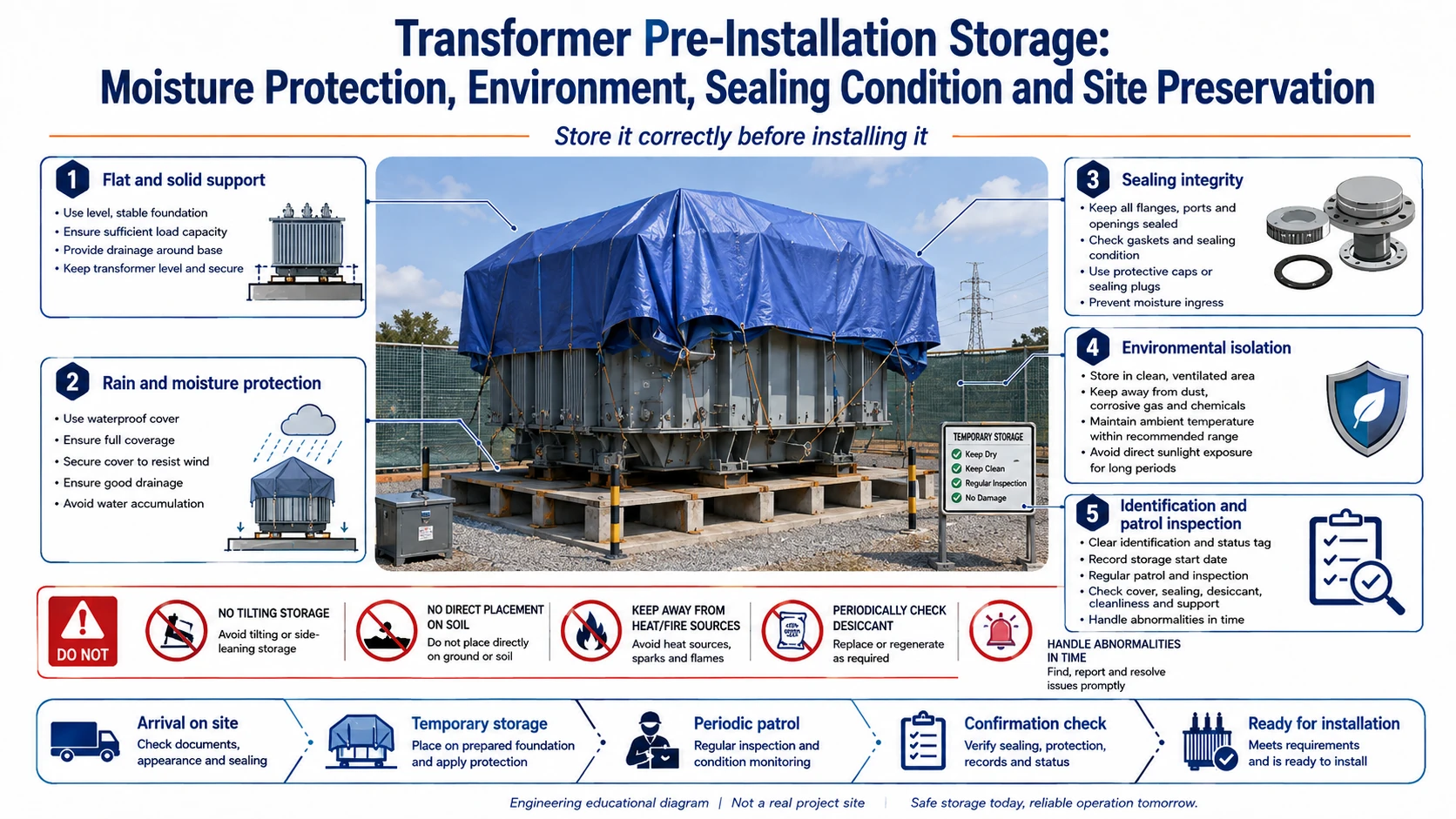
Start by confirming the transport and preservation state
Oil-immersed transformers can arrive in different transport configurations, and accessories may be preserved separately. The manufacturer transport and storage instructions should be the first reference for valves, sealing, breathers, protective covers, pressure or gas conditions where applicable, and the condition of separately packed accessories.
Do not apply storage habits from another model or voltage class without checking whether the preservation arrangement is the same.
Why humidity and weather matter
High humidity can accelerate corrosion and allow insulation materials to absorb moisture, reducing insulation resistance and complicating later commissioning. Outdoor or semi-outdoor storage also needs attention to rain, ponding water, solar exposure, contamination, salt-bearing environments and condensation created by temperature swings.
The objective is not one universal humidity number. It is to keep the equipment within the preservation conditions defined by the manufacturer and project.
The mechanical environment does not end after unloading
After arrival, equipment may still be lifted, shifted, forked, re-blocked or moved to a final foundation. Temporary storage should minimize unnecessary re-handling, maintain a stable orientation and support, and protect exposed interfaces, instruments and accessory packages from impact or contamination.
What a storage record should contain
At minimum, record the date, equipment identity, storage location, visible/sealing condition, environmental abnormalities, accessory-package state and any site action taken. For longer storage periods, the inspection frequency and content should follow the manufacturer instructions and project procedure.
Before installation begins, perform a documented status recheck instead of assuming that the condition seen weeks or months earlier is unchanged.
Frequently Asked Questions
If the transformer remains in its original packaging, is periodic inspection unnecessary?
No. Original packaging helps preserve the equipment, but long-term condition still needs to be managed according to manufacturer and project requirements.
Should the team open the transformer to inspect internally during storage?
Not unless the manufacturer and project procedure require it. Uncontrolled opening, oil addition or gas addition can compromise preservation and evidence.
What deserves extra attention for coastal storage?
High humidity and salt-bearing environments can increase corrosion and external-insulation stress. Storage controls should reflect the project environment, packaging and manufacturer preservation requirements.
Technical References
- Qin Ganghua, Wang Zhanhong, Wang Xin, et al.. 《火力发电企业绝缘技术监督手册》 [Insulation Technical Supervision Manual for Thermal Power Enterprises]. Zhejiang University Press, 2021. Consulted for transformer transport/storage, arrival control, installation and handover-test boundaries.
- Editorial Board of Electrical Engineer Handbook, 4th ed.; Wang Jianhua, ed.. 《电气工程师手册(第4版)》 [Electrical Engineer Handbook, 4th Edition]. China Machine Press, 2024. Consulted for shock, vibration, humidity and transport/storage mechanical-environment factors.
Project-specific limits, inspection criteria, test sequence, protection settings and commissioning decisions require written confirmation from the applicable project specification, owner or utility, manufacturer and responsible engineer.