Dry-Type Transformer Buying Guide · Batch 6
Dry-Type Transformer Price: Buyer’s Guide to Cost, RFQ and Indoor Project Selection
Published 2026-07-28 · Prepared by the TransformerGrid technical editorial team · Project-specific requirements require manufacturer, utility and applicable-standard verification.
A dry-type transformer price is not a fixed number attached to a kVA rating. The quotation changes with primary and secondary voltage, insulation system, winding material, temperature rise, enclosure, ventilation, harmonics, tests, documentation and delivery scope. Two offers that appear to describe the same transformer may therefore represent different equipment and different project risk.
This guide is written for buyers, EPC teams, distributors and facility owners who need a comparable quotation rather than a headline price. It explains which technical decisions move cost, how to build a usable RFQ, how to separate equipment price from installed project cost, and how to review a supplier without assuming that every certificate or test report covers the offered design.
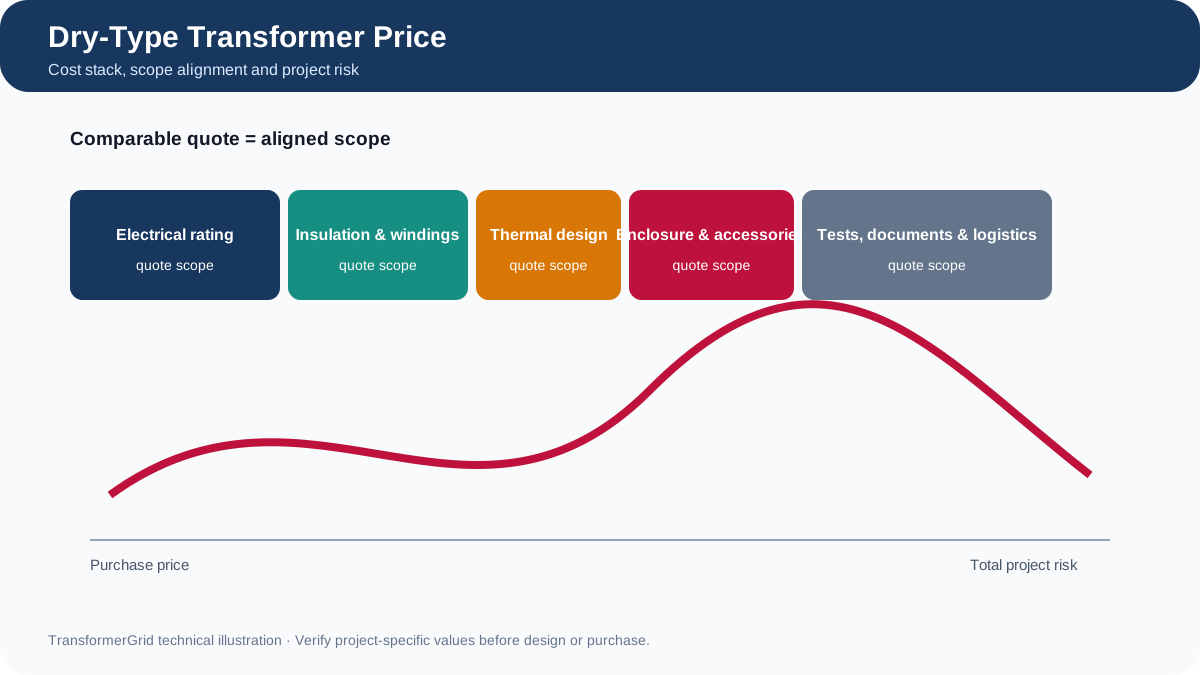
Why the kVA rating is only the first line of the quotation
A rating such as 500 kVA or 1000 kVA establishes the apparent-power requirement, but it does not define the transformer. The manufacturer still needs system voltage, frequency, phase, connection, impedance, tap range, insulation level, ambient condition and load profile. A 1000 kVA unit serving linear building loads is not the same commercial scope as a 1000 kVA unit feeding UPS systems and variable-frequency drives.
The price also changes when the buyer asks for cast-resin insulation instead of VPI, copper instead of aluminum, a lower temperature rise, forced-air capacity, a protected enclosure, winding temperature monitoring, special terminals or a witnessed factory acceptance test. The first hard gate is therefore simple: do not compare prices until each supplier is answering the same specification.
The eight cost groups buyers should separate
A useful comparison divides the quote into eight groups: electrical rating; insulation system; winding and core materials; thermal design; enclosure and ventilation; accessories and monitoring; tests and documentation; logistics and commercial scope. This structure prevents an attractive base price from hiding excluded items.
For example, one supplier may include an enclosure, temperature controller, six sensors and routine test reports, while another prices only the active part. One may include two drawing revisions and English reports; another may charge each revision separately. When these differences are placed in separate rows, procurement can see whether the price gap is a manufacturing advantage or merely a scope gap.
Cast resin, VPI, copper and aluminum
Cast resin and VPI are both dry-type technologies, but they use different insulation processes and can be selected for different environmental, maintenance and budget priorities. Cast resin is often considered where humidity, contamination or clean indoor installation is important. VPI may be appropriate in controlled environments where a simpler insulation architecture and lower initial cost are acceptable.
Copper and aluminum should also be compared as complete designs rather than as raw-material labels. The buyer should review losses, current density, temperature rise, dimensions, mass, terminals, short-circuit mechanical design and life-cycle energy cost. A lower-priced conductor choice can still be the better project decision, but only after the complete performance is visible.
Purchase price versus installed and operating cost
The transformer invoice is only one part of the project. Indoor-room ventilation, fire strategy, cable routing, lifting access, floor loading, switchgear interface, commissioning and downtime may cost as much as the difference between competing transformers. A dry-type unit can simplify some oil-management requirements, but it still releases heat into the room and requires clear airflow and maintenance access.
Operating cost is driven mainly by no-load loss, load loss, actual load factor, electricity price and operating hours. The lowest purchase price may not produce the lowest total cost if the unit remains energized for many years at a predictable load. Buyers should request guaranteed losses and use the same capitalization assumptions across all offers.
What a complete RFQ and quotation should contain
A practical RFQ should state project country, application, kVA, voltage, phase, frequency, connection, impedance target, tap requirement, ambient temperature, altitude, indoor environment, load type, expected harmonics, cooling method, enclosure, cable interface, accessories, required tests, document language, delivery term and target date. Unknowns should be marked as open points rather than hidden.
A complete quotation should answer those points, list deviations, identify the actual manufacturing party, define the included drawings and tests, state the warranty and Incoterm, and separate optional items. TransformerGrid can coordinate this clarification and comparison process with verified manufacturing partners, while final site design, protection settings and local approvals remain the responsibility of qualified project parties.
FAQ
Can a supplier quote from only kVA and voltage?
A budgetary estimate is possible, but a purchase-ready quotation should confirm connection, impedance, insulation system, thermal design, enclosure, load characteristics, tests and documents.
Is cast resin always more expensive than VPI?
It is often priced higher because the process and material system differ, but the actual difference depends on rating, manufacturer, enclosure, tests and project requirements.
Does a dry-type transformer eliminate ventilation requirements?
No. Losses become heat in the room. The enclosure and room ventilation must allow that heat to leave without exceeding the design temperature.
How should buyers compare two prices?
Use a line-by-line matrix covering electrical data, materials, losses, temperature, enclosure, accessories, tests, documents, delivery and warranty.
Send your dry-type transformer RFQ
We can help organize the technical data, open points, drawings, FAT documents and comparable quotation scope with verified manufacturing partners.