Dry-Type Transformer Buying Guide · Batch 6
1000 kVA Dry-Type Transformer Price: What a Complete Technical Quote Should Include
Published 2026-07-28 · Prepared by the TransformerGrid technical editorial team · Project-specific requirements require manufacturer, utility and applicable-standard verification.
At 1000 kVA, a dry-type transformer quotation becomes more sensitive to heat, current, room design, harmonics and project documentation. The unit may serve a data center, hospital, process line, large commercial building or industrial distribution board where downtime and thermal margin matter more than a small difference in purchase price.
A complete technical quote should show the assumptions behind the price and make deviations visible. This guide focuses on the commercial scope; the paired Technical Library page explains K-factor and harmonic heating in greater depth.
Why 1000 kVA is not simply twice a 500 kVA quotation
Higher current increases conductor, terminal and bus interface requirements. The active part and enclosure become larger, ventilation paths become more important, and site lifting and access may require separate planning. A design that is easy to install at 500 kVA can create room-layout constraints at 1000 kVA.
The buyer should provide the actual one-line diagram, expected loading, duty cycle and room information whenever possible. Budgetary assumptions should be listed explicitly and replaced by confirmed data before production.
Losses, temperature rise and operating cost
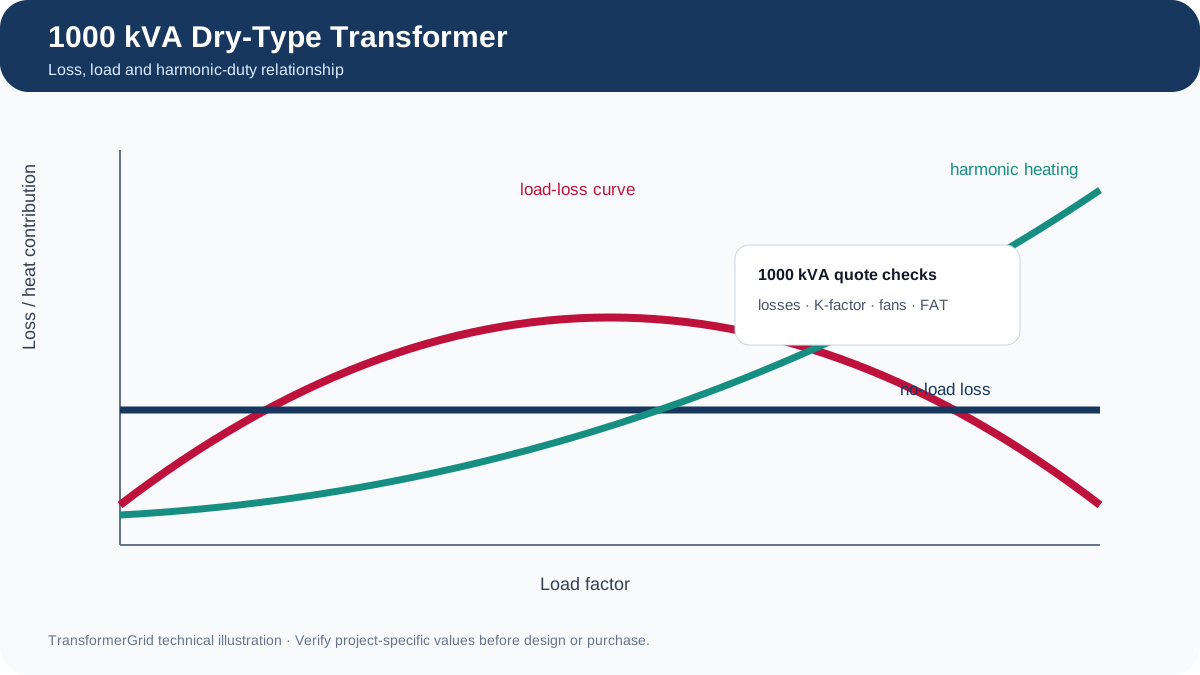
Guaranteed no-load and load losses deserve close attention because the unit may remain energized continuously. Load loss rises with current, while no-load loss is present whenever the transformer is energized. The preferred design depends on actual load factor and energy-cost assumptions.
A lower temperature-rise design can provide thermal margin but may require additional conductor, core or cooling surface. The quotation should state insulation class, specified temperature rise, ambient basis and whether the rating is AN, AF or both.
UPS, VFD and other nonlinear loads
Data centers and modern industrial facilities often include rectifiers, UPS systems, variable-frequency drives and switch-mode power supplies. These loads create harmonic currents that increase eddy-current and stray losses. A standard kVA check may therefore underestimate thermal duty.
The RFQ should identify the nonlinear load percentage or provide available harmonic information. If a K-rated design is required, the quotation should state the rating and the assumptions used rather than adding a K label without explanation.
Monitoring, enclosure and room interface
A 1000 kVA project may require winding temperature sensors, a controller, fan staging, alarms, communication contacts and specific cable-entry arrangements. These items affect both price and commissioning responsibility. They should appear in the accessory schedule and drawings.
The room must remove transformer losses as heat. The equipment supplier can provide loss data and enclosure airflow information, but the building engineer must verify room ventilation, fire strategy, access, structural loading and local code requirements.
FAT, deviations and document control
Large projects often involve several review parties. The quote should identify routine tests, any special or witnessed tests, test-report language, drawing schedule, number of review cycles and final as-built deliverables. A deviation schedule should show every point where the offer differs from the RFQ.
The safest commercial decision is made after technical deviations are closed, not before. TransformerGrid can coordinate these clarification and documentation steps with verified manufacturing partners while local engineering and approval remain project responsibilities.
FAQ
Why can two 1000 kVA prices differ widely?
They may use different loss levels, winding material, temperature rise, K-factor, enclosure, monitoring, tests or document scope.
Should every 1000 kVA unit be K-rated?
No. K-factor should reflect the expected harmonic duty. A largely linear load may not need the same design as a UPS-heavy facility.
Is a lower temperature rise always better?
It can provide margin, but it may increase size and cost. The project should evaluate the benefit against actual ambient and loading.
What document best exposes quotation differences?
A technical deviation schedule shows where each offer departs from the requested scope.
Send your dry-type transformer RFQ
We can help organize the technical data, open points, drawings, FAT documents and comparable quotation scope with verified manufacturing partners.