Technical Wiki · No. 17
Transformer WTI, OTI, Oil-Level Gauge and Cooling-Control Circuits: Measurement, Alarms, Starting and Signal Consistency
OTI and WTI have different jobs
OTI indicates oil temperature. WTI provides an indication or signal associated with winding thermal condition. The exact sensing principle and thermal model depend on the product design. A purchase specification should therefore say more than “temperature indicators included”: it should define the measured quantity, range, number of contacts, output type, accuracy, installation position and remote interface.
Verify the signal chain section by section
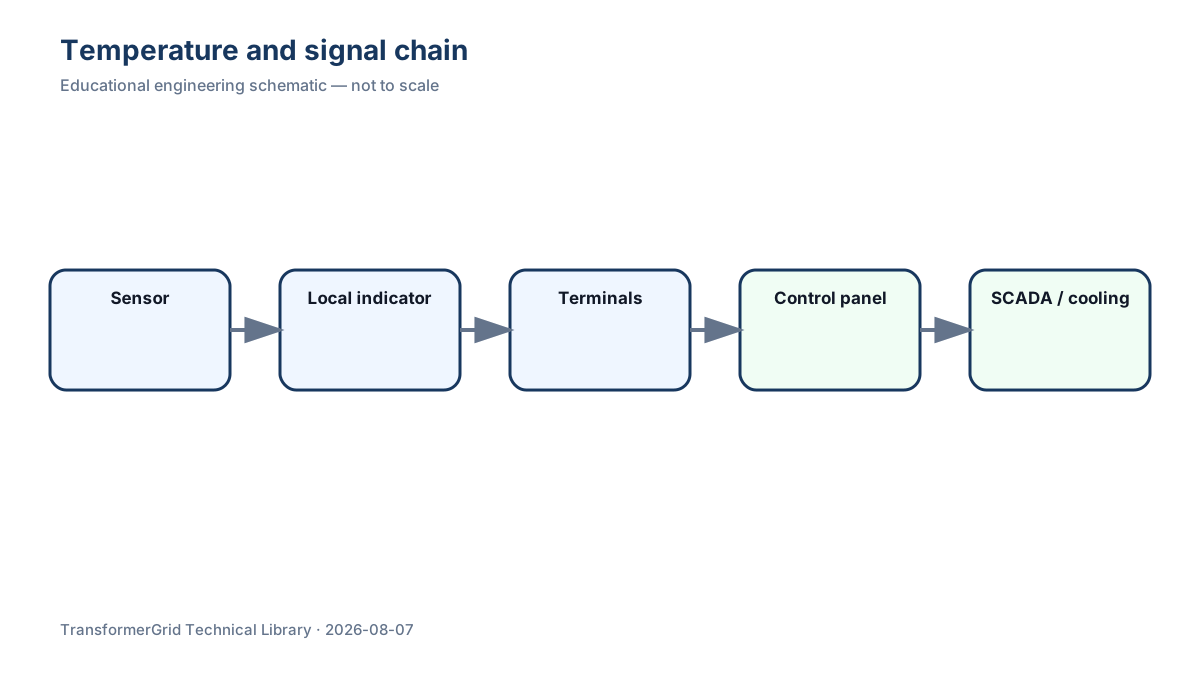
From the local instrument to the control cabinet and then to DCS or SCADA, the value passes through sensing, conversion, wiring and point mapping. Local, control-room and supervisory values should remain reasonably consistent. If they disagree, the chain should be checked section by section instead of hiding the discrepancy with software compensation.
Alarm, cooling start and trip functions
Temperature devices often provide several contacts for alarms and cooling-equipment starting. Operating guidance treats winding-temperature and top-oil-temperature contacts primarily as signal or control inputs rather than assuming a universal trip function. Final contact use, setpoints and any trip strategy must be defined by the project protection/control design and operating rules.
Read oil level together with temperature
Conservator oil level changes with oil temperature. The level indicator may also provide alarm contacts. The supervisory system should retain oil temperature, oil level and cooling status together so a single high/low alarm is not used by itself to conclude that the transformer is leaking or overheating.
FAT and site commissioning
Point-by-point tests should verify local indication, remote analog values, alarm contacts, fan or pump starts, failure feedback, auxiliary-supply changeover and the supervisory display. Temperature control and indication should be consistent, and automatic cooling start should function correctly. Test records should state the applied input, actual operate value, reset value and terminal number.
Periodic calibration and inspection
Temperature instruments should be calibrated at appropriate outage intervals. Infrared thermography can provide additional external temperature evidence during operation, but it reflects surface thermal condition and cannot directly replace internal winding-temperature indication. Trend, load, ambient temperature and cooling status should be evaluated together.
Conclusion
Reliable temperature protection depends on the complete signal chain. Accurate instruments, correct wiring and a clear point list are all necessary.
Frequently Asked Questions
If WTI and OTI show different temperatures, does that automatically mean a fault?
No. They may measure different thermal quantities through different chains, although abnormal discrepancies still need to be checked against the design.
Can infrared temperature replace WTI?
No. Infrared thermography mainly shows surface thermal condition and is supporting evidence, not a direct substitute for winding-temperature indication.
Technical References
- Qin Ganghua, Wang Zhanhong, Wang Xin, et al. 《火力发电企业绝缘技术监督手册》 [Insulation Technical Supervision Manual for Thermal Power Enterprises]. Zhejiang University Press. Consulted for: Winding temperature, top-oil temperature, operating contacts, cooling control and signal consistency.
- Sun Kejun, et al. 《电工手册》 [Electrical Engineering Handbook]. China Machine Press. Consulted for: Temperature control, temperature indication, automatic cooling start, oil level and pre-energization checks.
- Zhou Qiukuan, Liu Mingjun, Liu Yan, et al. 《电力设备带电检测技术及应用》 [Live Detection Technologies and Applications for Power Equipment]. Jinan University Press. Consulted for: Infrared thermography applicability and the boundary between surface temperature evidence and internal thermal diagnosis.
Final engineering values, setpoints and operating decisions require written confirmation from the project engineer, owner or utility and manufacturer.