Transformer Sizing & Load Reality · W5
Three-Phase Load Imbalance, Neutral Current & Transformer Procurement
Direct answer: Three-phase load imbalance cannot be assessed from total kVA alone. Uneven single-phase loading creates different phase currents; in a four-wire system, neutral current is the phasor sum of the phase currents, not a simple arithmetic difference. Nonlinear single-phase loads can also create triplen harmonic currents that add in the neutral. The acceptable level of imbalance, neutral sizing, connection arrangement and mitigation strategy must follow the applicable measurement definition, project/utility requirements, actual harmonic content and system topology rather than a universal 10% or 20% threshold.
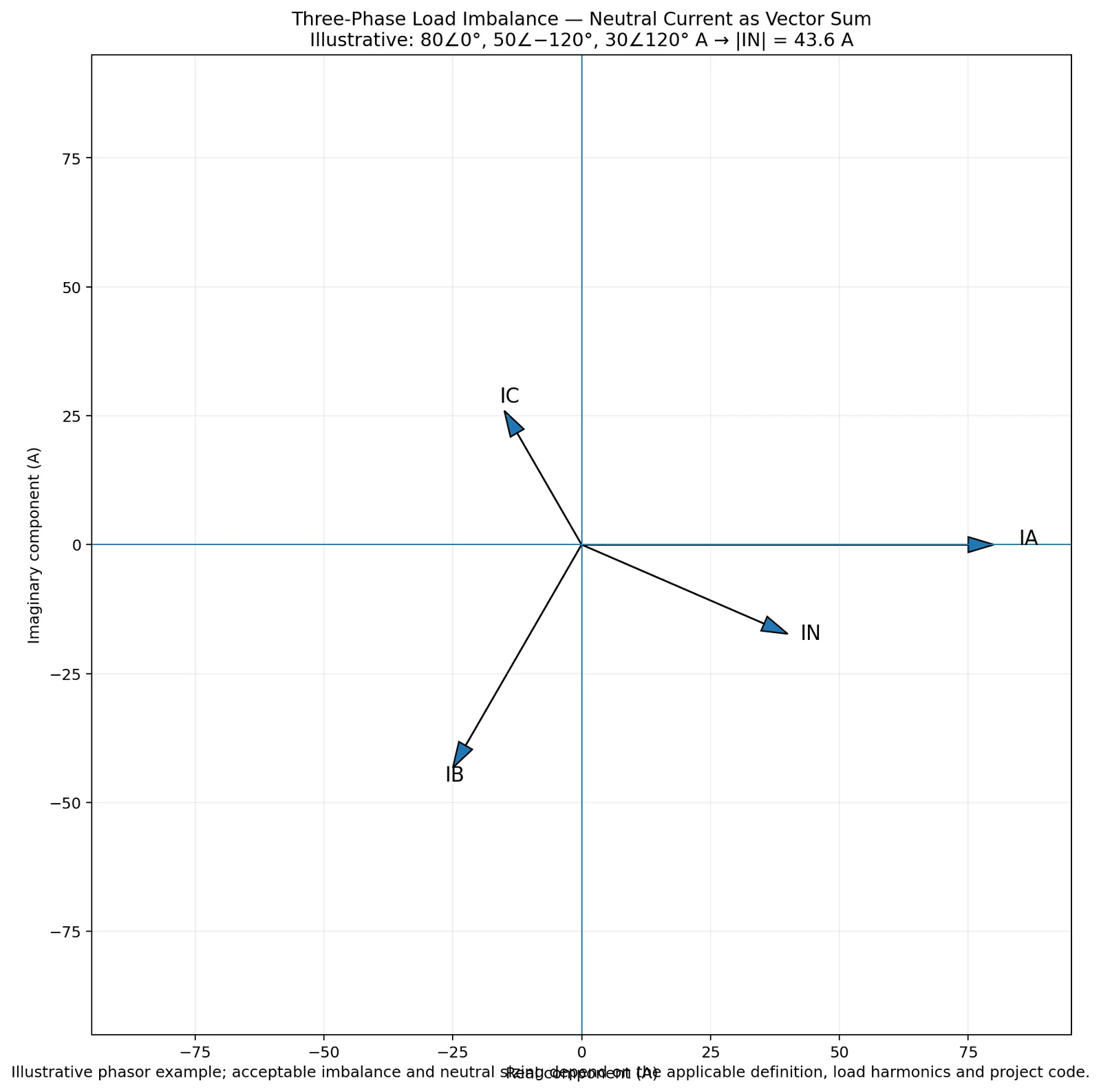
Unequal phase currents produce a non-zero vector sum in a four-wire system. The example is illustrative and does not define a universal acceptance threshold.
Why total kVA can hide a phase problem
- A three-phase transformer can be below its total nameplate kVA while one phase carries materially more current than the others. The most heavily loaded winding, conductor, terminal or downstream circuit does not receive relief simply because the other phases are lightly loaded.
- This is particularly relevant in commercial buildings, hotels, apartments, campuses and mixed facilities with many single-phase branch circuits.
“Unbalance” has more than one definition
- Engineering documents may express current imbalance as maximum deviation from average, or may use positive/negative-sequence component ratios. Voltage-unbalance definitions can differ again.
- These definitions should not be mixed. A procurement specification should state the metric, measurement point, time interval and governing utility/project standard before any acceptance number is applied.
Neutral current is a vector-sum problem
- For balanced linear phase currents 120 degrees apart, the fundamental phasor sum can approach zero. When the magnitudes are unequal, the vector sum is non-zero and can flow in the neutral of a four-wire system.
- The figure uses an illustrative 80∠0°, 50∠−120°, 30∠120° A example. The computed neutral-current magnitude is about 43.6 A. The values are examples only; they are not acceptance criteria.
Nonlinear loads make the neutral question more important
- Single-phase rectifier loads and other nonlinear equipment can produce triplen harmonics. Those harmonic components can add in the neutral even when the fundamental phase loading appears relatively balanced.
- Neutral conductor and terminal requirements should therefore follow the applicable electrical code, actual load composition and harmonic assessment rather than a fixed universal percentage of phase-conductor size.
Transformer and system effects
- Sustained high current in one phase increases I²R loss and thermal duty in that phase.
- Unbalance and harmonic current can add stray/eddy-current heating depending on the design and spectrum.
- Voltage unbalance and negative-sequence components can affect three-phase motors and sensitive equipment.
- Neutral, zero-sequence and vector-group behavior must be interpreted using the actual connection and grounding topology.
Vector group is not a universal cure
- Delta-wye and other connections can provide useful neutral/zero-sequence characteristics in specific systems, but no vector group should be presented as the universal fix for load imbalance.
- The first operational correction for uneven single-phase loading is often better load allocation, followed by engineering review of neutral, grounding, harmonics and protection as required.
Procurement and site verification
- Buyer: provide A/B/C phase load data or measured currents, single-phase/nonlinear load inventory, neutral/grounding arrangement and applicable power-quality requirement.
- Supplier: provide rated phase current, neutral-terminal configuration, vector group and any design information required for harmonic/thermal review.
- Site: trend phase current over representative operating periods, check neutral current and harmonic data where relevant, and investigate persistent imbalance at its source.
FAQ
What percentage of phase-current imbalance is always acceptable?
There is no single universal number without first defining the measurement method and governing requirement.
Why can one phase overheat if total kVA is below the transformer rating?
Total kVA does not show how current is distributed among the windings and conductors.
Will changing to Dyn11 solve the imbalance?
No. Vector group is one part of the system architecture; load imbalance requires analysis of load allocation, neutral, grounding, harmonics and protection.
Related Story from the Blog:
Buying or sourcing a transformer? Contact: [email protected]