Technical Library · Dry-Type Transformer Cluster
K-Factor and Harmonics in Dry-Type Transformers: K-4, K-13, K-20, UPS and VFD Loads
Technical reference updated 2026-07-28. Final design, testing and installation requirements must follow the project specification, applicable standards, local authority and qualified engineering review.
Nonlinear loads draw current in pulses rather than as a smooth sinusoid. UPS systems, variable-frequency drives, rectifiers, server power supplies and many electronic devices can therefore produce harmonic current that increases transformer heating.
K-factor is one way of expressing the additional winding and stray-loss duty, but it should be selected from the actual load rather than chosen as the highest available label.
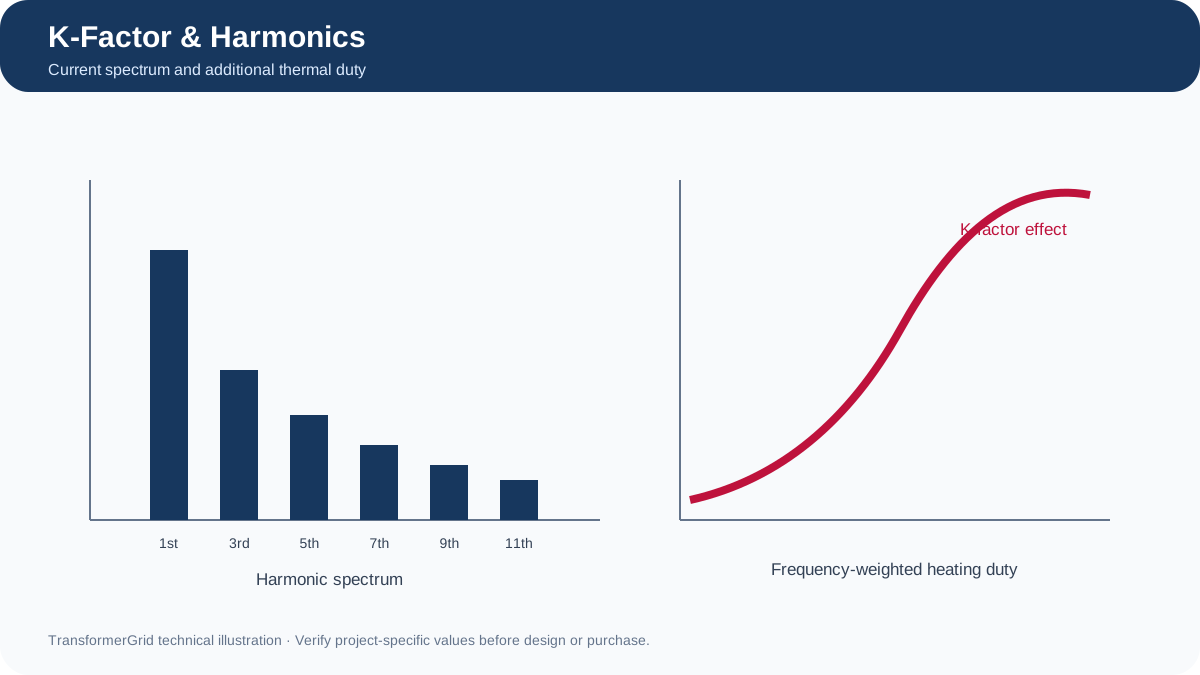
Why harmonics increase heating
Harmonic current produces additional I²R and frequency-dependent eddy-current losses in conductors and structural parts. Higher-order components can create disproportionate heating even when RMS current appears acceptable.
Triplen harmonics can add in the neutral of four-wire systems, which affects conductor and terminal design. The transformer connection and downstream distribution should be reviewed together.
What K-factor represents
K-factor weights harmonic current components according to their order to represent relative eddy-current heating duty. Ratings such as K-4, K-13 and K-20 are commonly specified for increasing nonlinear-load severity.
The label does not replace a complete design review. Manufacturers may use different conductor arrangements, shielding, neutral sizing and thermal margins.
UPS and VFD applications
Large UPS systems and data-center loads can create significant harmonics, although modern front ends may have improved current waveforms. VFD harmonic performance depends on topology, filtering and loading.
The RFQ should identify equipment type, expected nonlinear-load share, available harmonic study and future expansion. Assuming every UPS project needs the same K rating can overspecify or underspecify the transformer.
Relationship to temperature rise and losses
A K-rated design is intended to manage additional harmonic heating within the specified thermal limits. It can require changes to conductor size, transposition, neutral, core flux, shielding and cooling. These changes affect cost, size and efficiency.
The room ventilation calculation should use the guaranteed losses for the offered harmonic-duty design, not a generic standard unit.
A practical specification method
If measured or modeled harmonic spectra are available, provide them. Otherwise describe load types, quantities, duty and diversity, then ask the manufacturer to state assumptions and recommend a rating.
Document the reason for the selected K-factor and verify that the offered design, nameplate and test documents are consistent.
FAQ
Does every UPS require a K-rated transformer?
No. The need depends on UPS topology, harmonic performance, load share and project requirements.
Is K-20 always safer than K-13?
Not automatically. It may add cost and size without benefit if the harmonic duty is lower.
Does K-factor address voltage harmonics?
It primarily relates to current-harmonic heating. The complete power-quality study may include other issues.
Can harmonic heating be solved by oversizing only?
Oversizing may provide margin, but a purpose-designed harmonic-duty transformer can address conductor and stray-loss mechanisms more directly.
This page is educational. TransformerGrid coordinates RFQ clarification, drawings, documentation, FAT and export delivery with verified manufacturing partners; it does not replace the utility, local design authority or qualified installation contractor.