Technical Library · Dry-Type Transformer Cluster
Dry-Type Transformer Ventilation and Enclosures: NEMA, IP, Clearances and Indoor Room Design
Technical reference updated 2026-07-28. Final design, testing and installation requirements must follow the project specification, applicable standards, local authority and qualified engineering review.
A dry-type transformer does not contain a conventional oil cooling system, so electrical losses become heat that must move through the enclosure and leave the room. Poor ventilation can raise winding temperature, reduce capacity and shorten insulation life.
The transformer enclosure and the electrical room should therefore be reviewed as one thermal system.
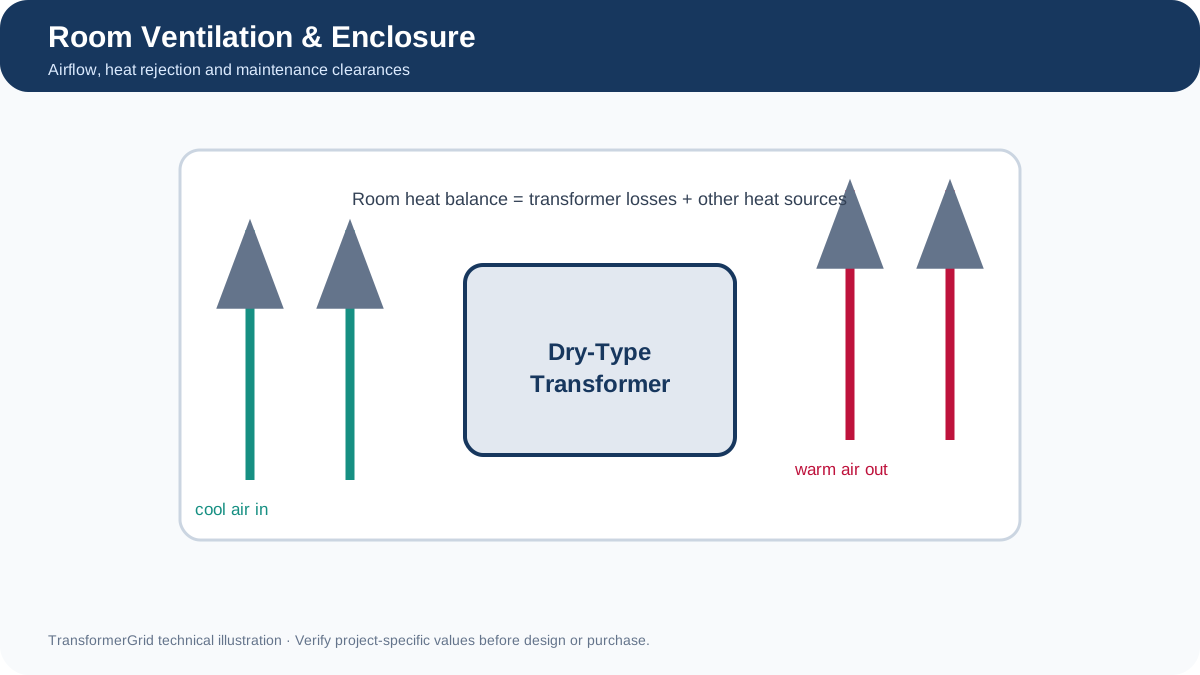
Heat balance in the room
Guaranteed no-load and load losses provide the starting heat input. The room ventilation or HVAC system must remove that heat while keeping the ambient around the transformer within the design basis.
The calculation should also include other equipment, solar gain, occupancy, altitude and operating profile where relevant. A nominal room temperature is not sufficient if hot air recirculates at the transformer inlet.
Natural airflow and forced ventilation
Natural ventilation depends on low-level cool-air entry and high-level warm-air exit with adequate free area and pressure path. Mechanical ventilation can provide controlled airflow but requires power, controls, reliability and maintenance.
Air should not short-circuit directly from supply to exhaust without sweeping the transformer. Louvers and ducts should avoid directing dust or moisture onto energized parts.
NEMA and IP enclosure concepts
NEMA and IP designations describe different classification systems and should not be treated as direct one-to-one equivalents. The purchase specification should use the system required by the project and define indoor or outdoor exposure.
More protection can restrict airflow. The manufacturer must integrate louver area, baffles, filters and clearances into the thermal design.
Clearances, cable entry and maintenance
Required clearances depend on voltage, enclosure, manufacturer instructions, local code and maintenance method. Space is needed for doors, removable panels, cable bending, fan replacement, inspection and eventual transformer removal.
Top or bottom cable entry, busway connection and adjacent switchgear can change airflow and access. These interfaces should be shown on the general arrangement.
Information to exchange during RFQ
The buyer should provide room dimensions, ambient, altitude, airflow concept, nearby heat sources, enclosure requirement, cable route and maintenance constraints. The supplier should provide losses, dimensions, mass, airflow path, clearances and accessory heat loads.
Final room design and code compliance remain the responsibility of qualified local engineers.
FAQ
Can a dry-type transformer be placed in a sealed room?
Only if a designed cooling system removes the transformer and room heat while maintaining acceptable ambient conditions.
Are IP20 and NEMA 1 identical?
No. They come from different classification systems and should not be assumed equivalent without review.
Do fans remove heat from the building?
Transformer fans improve local airflow; room ventilation or HVAC must still reject heat from the room.
Why is cable entry part of ventilation review?
Cables, busways and partitions can block airflow and maintenance access.
This page is educational. TransformerGrid coordinates RFQ clarification, drawings, documentation, FAT and export delivery with verified manufacturing partners; it does not replace the utility, local design authority or qualified installation contractor.
Project context matters.