Technical Library · Dry-Type Transformer Cluster
Insulation Class and Temperature Rise in Dry-Type Transformers: Class F, Class H, AN and AF
Technical reference updated 2026-07-28. Final design, testing and installation requirements must follow the project specification, applicable standards, local authority and qualified engineering review.
Insulation class, temperature rise and cooling method are related but different specifications. Confusing them can produce an oversized quotation, an overheated installation or a false claim that one design will automatically last longer.
This page explains the thermal language used in dry-type transformer offers and shows how Class F, Class H, AN and AF should be interpreted together.
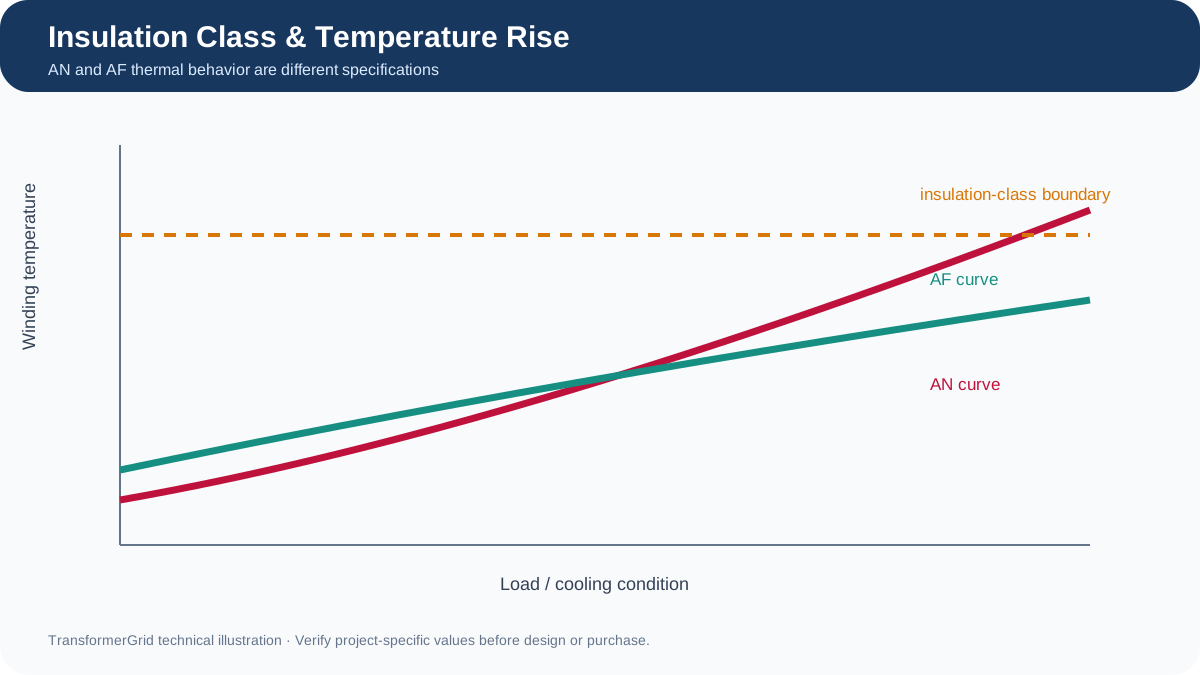
Insulation class is a material-system limit
The insulation class identifies the thermal capability of the insulation system under defined conditions. Class F and Class H are common references in dry-type equipment, but the class is not the same as the specified temperature rise.
A design can use a higher-class material system while operating at a lower rise to provide margin. The buyer should ask for both values.
Temperature rise and ambient temperature
Temperature rise describes how far the winding temperature increases above the reference ambient under specified loading and test conditions. The resulting operating temperature depends on ambient, rise, hot-spot gradient and actual loading.
A unit installed in a hotter room or at high altitude may require derating or design adjustment. Project assumptions should be stated in the quotation.
Thermal aging is nonlinear
Insulation aging accelerates as operating temperature increases. The exact life relationship depends on material system, moisture, manufacturing and loading, so a simple universal life claim is not appropriate.
Continuous overload, blocked airflow, dust and fan failure can move the transformer away from its expected thermal condition even when the nameplate rating appears adequate.
AN and AF cooling
AN is natural-air cooling. AF uses fans to move more air through the transformer and enclosure. AF may support a higher rating or provide short-term contingency, but it introduces controls, sensors, alarms and maintenance.
The offer should state the base AN rating, AF rating if any, fan staging and what happens after a fan or controller failure.
How to specify thermal requirements
State ambient temperature, altitude, load profile, nonlinear loads, desired temperature rise, insulation class, enclosure and room ventilation. Avoid specifying an arbitrary class or fan package without explaining the project need.
A technically aligned RFQ lets suppliers optimize material and cost while preserving the required thermal margin.
FAQ
Is Class H always better than Class F?
Not automatically. Operating rise, ambient, loading and design quality matter as much as the class label.
Does lower temperature rise increase cost?
It can require more conductor, core or cooling surface, so cost and dimensions may increase.
Can AF fix a hot room?
No. Fans move air through the transformer but the room still must remove the heat.
What should be shown on the data sheet?
Insulation class, specified temperature rise, ambient basis, AN rating, AF rating and fan-control details.
This page is educational. TransformerGrid coordinates RFQ clarification, drawings, documentation, FAT and export delivery with verified manufacturing partners; it does not replace the utility, local design authority or qualified installation contractor.