Normal Hum or Warning Sign? An Engineering Guide to Abnormal Transformer Sounds and Vibration
Published July 22, 2026 · Engineering coordination review by TransformerGrid · Project-specific requirements require manufacturer, utility and applicable-standard verification.
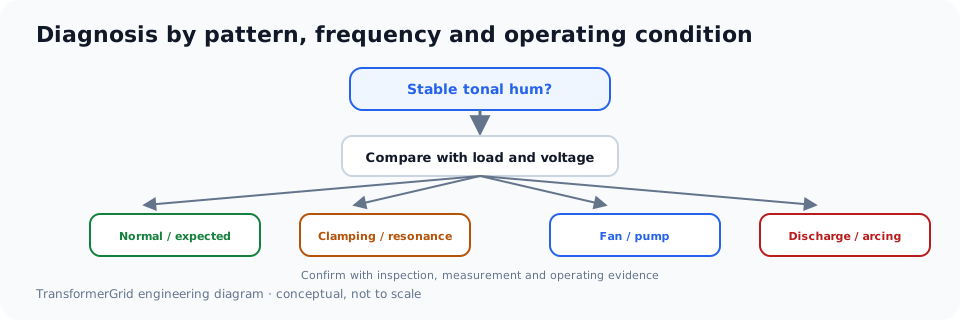
To judge whether a transformer sound is abnormal, first ask whether it departs from that unit’s established baseline. Different ratings, constructions, frequencies, loads and sites naturally sound different.
Level 1: record and observe
A stable long-term low-frequency hum without temperature, oil-level, protection or electrical abnormality can usually be documented for trending. Record time, position, voltage, load, cooling status and a repeatable reference sample.
Level 2: plan a qualified inspection
A new panel rattle, fan-bearing tone, local narrow-band increase or evidence of structure-borne vibration warrants inspection of accessible external fastening, foundation, accessories and cooling equipment under the site safety procedure. Compare load, voltage and temperature before drawing conclusions.
Level 3: execute the emergency procedure
Explosive, persistent arcing-like or heavy-impact sounds—or any sound accompanied by smoke, odor, oil release, rapid heating, bushing abnormality or protection operation—require safe distance and the owner/utility isolation and emergency process. Do not approach energized equipment merely to capture a recording.
Use multiple independent signals
Combine sound/spectrum with vibration, three-phase voltage and current, thermal or infrared observations, oil level and alarms, and when justified DGA, partial-discharge or electrical tests. Agreement among independent indicators provides stronger evidence than an internet recording that “sounds similar.”
Close the loop
Record the sound before and after corrective work, the exact fastening or component change, and comparable load/environmental conditions. A consistent history separates seasonal and operating changes from equipment-state changes.
This framework does not replace the manufacturer’s instructions, site safety rules or diagnosis by qualified personnel. Return to the sound and vibration engineering guide.
Technical Questions and Engineering Discussion
To discuss abnormal sound, vibration or inspection planning, contact [email protected]. Technical exchanges are welcome.
Primary engineering references
- IEC 60076-10:2016 — determination of transformer and reactor sound levels.
- IEC 60076-10-1:2016 and Amendment 1:2020 — application guidance.
- IEEE C57.136-2023 — sound and vibration guidance for liquid-immersed power transformers.
- NEMA TP 80050-2013 (R2024) — audible sound levels for distribution transformers.
Standards must be applied within their stated scope and the edition incorporated into the project documents. This page is an engineering reference, not a substitute for the governing contract, utility specification or safety procedure.