Measuring Transformer Sound: Background Noise, Distance, Reflecting Surfaces and Test Conditions
Published July 22, 2026 · Engineering coordination review by TransformerGrid · Project-specific requirements require manufacturer, utility and applicable-standard verification.
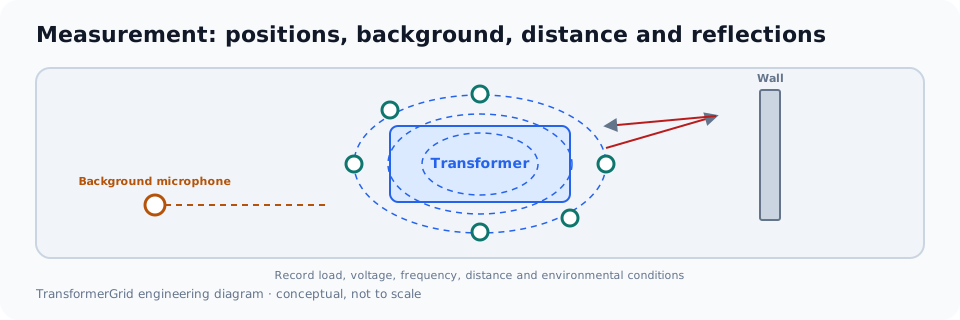
A measurement plan begins by defining its purpose. Factory source performance, the vicinity of an installed unit, a property boundary and a hotel room are different assessments with different receiver positions and possibly different governing criteria.
Before measurement
- Identify the transformer, rating, tap and operating state.
- Record meter and calibrator class, settings and calibration before and after the survey.
- Define the measurement contour or receiver points with coordinates and height.
- Prepare a site sketch and photographs of reflecting surfaces.
Background sound
Traffic, wind, rain, insects, people and other equipment can control the result. Record appropriate source-on and background conditions and apply only the correction permitted by the governing method. If separation is insufficient, state the limitation or repeat the survey.
Distance and reflections
The often-quoted 6 dB reduction for distance doubling applies only as an idealized point-source free-field approximation. Transformer dimensions, near-field behavior, hard ground, walls, roofs, fences and vehicles create departures. Formal testing follows the prescribed contour and correction method.
Operating and weather data
Record voltage, frequency, tap, load, harmonic distortion, cooling stage, wind, precipitation and relevant temperatures. A mobile application can help locate a change but generally should not be the sole contractual instrument.
Minimum report content
Purpose, standard, date/time, equipment condition, instruments, calibration, background, weather, locations, totals and bands, corrections, uncertainty, photographs and conclusion limits.
Return to the sound and vibration engineering guide.
Technical Questions and Engineering Discussion
To discuss a measurement plan or data comparability, contact [email protected]. Technical exchanges are welcome.
Primary engineering references
- IEC 60076-10:2016 — determination of transformer and reactor sound levels.
- IEC 60076-10-1:2016 and Amendment 1:2020 — application guidance.
- IEEE C57.136-2023 — sound and vibration guidance for liquid-immersed power transformers.
- NEMA TP 80050-2013 (R2024) — audible sound levels for distribution transformers.
Standards must be applied within their stated scope and the edition incorporated into the project documents. This page is an engineering reference, not a substitute for the governing contract, utility specification or safety procedure.