Both Transformers Passed. Why Did We Still Refuse to Close the Bus Tie?
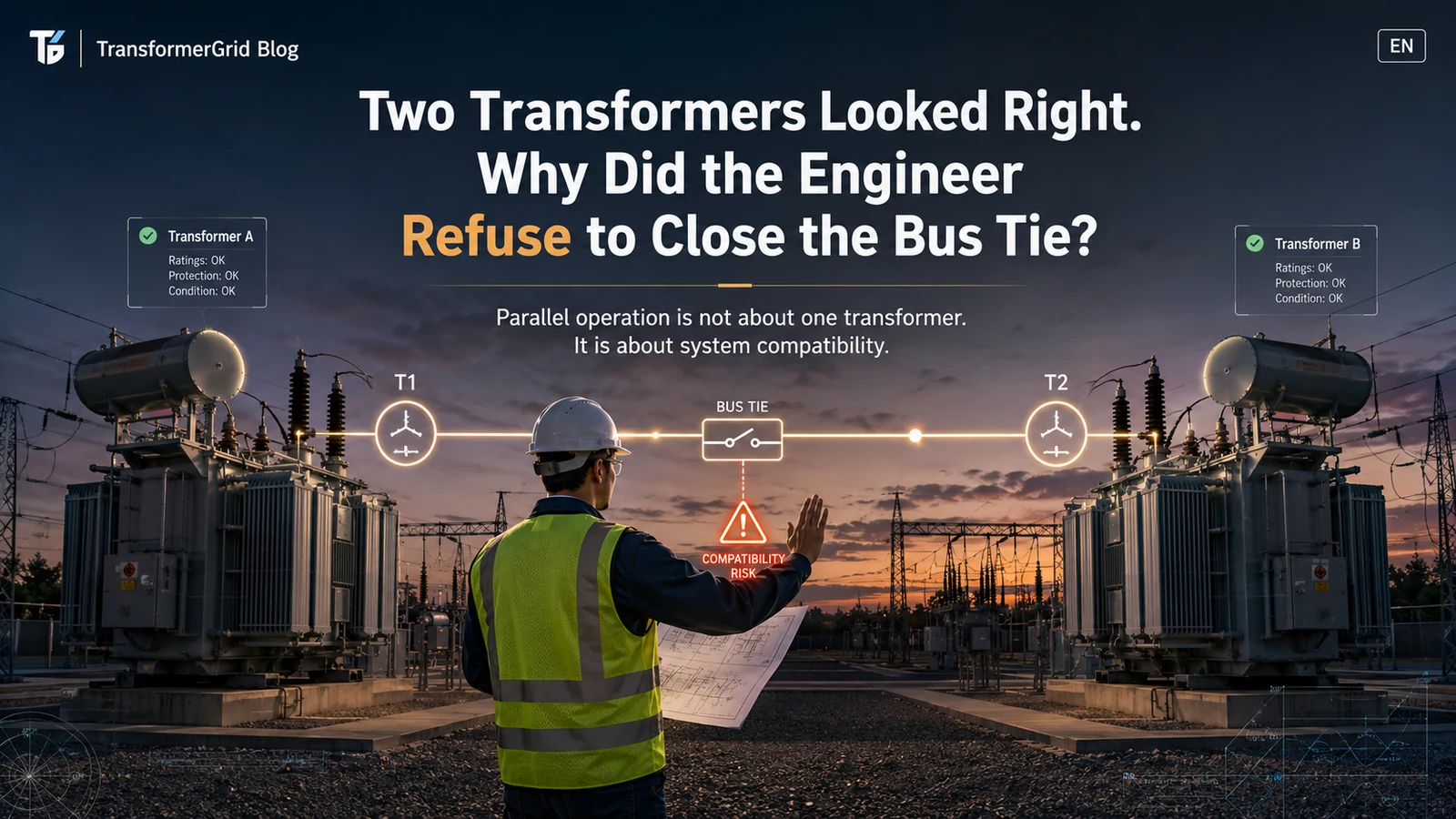
The most dangerous word in a transformer project can be “passed”
Daniel had two 1500 kVA transformers. The older unit had operated for years. The new unit passed FAT. Each transformer could be energized by itself and the secondary voltage looked normal. Everyone saw one final step: close the bus tie.
If TransformerGrid were only a quote-forwarding seller, this would be the easiest moment to disappear. The equipment was supplied, FAT was complete, and whatever happened next could be called “a site issue.” That is exactly the kind of handoff we do not want.
A transformer passing by itself proves something about that transformer. It does not prove that two sources can be connected to the same bus. The moment a project says N+1, expansion, replacement, bus tie or long-term paralleling, TransformerGrid stops looking at the new transformer alone and starts looking at the pair.
Why we ask the questions that slow a quotation down
We ask for the existing unit’s connection or vector group, present tap position, percent impedance, phase rotation, neutral and grounding arrangement, and the intended operating mode. Will the transformers remain paralleled continuously, or is the tie only for transfer? Was protection studied for one source or two?
Those questions do not sound like sales questions. They are the questions that separate a transformer that is merely buildable from a transformer that actually belongs in the project.
TransformerGrid would rather spend time on an uncomfortable question before the PO than let the customer discover the same question with two live buses and an outage window running.
We are not trying to sell a steel box
Two units can both say 1500 kVA and 480 V and still be a poor parallel match. A tap or ratio mismatch can create circulating current. A phase relationship mismatch can make the bus tie impossible. Different impedance can shift load toward one unit. Grounding and protection can change how the system behaves during a fault.
The technical details belong in engineering documents. The buying lesson is simpler: individually acceptable does not mean system-compatible.
That sentence is one of the reasons TransformerGrid exists. We want compatibility questions at the front of procurement, not at the end of commissioning.
What TransformerGrid actually does
For expansion, N+1, old-plus-new and dual-transformer bus projects, we prefer to collect the existing nameplate, one-line diagram, impedance, connection, tap, grounding and protection interfaces before finalizing the new unit.
What can be confirmed, we confirm. What belongs to the EPC or consultant, we identify as an open item. What requires drawings or data from the manufacturing side, we coordinate with a verified manufacturing partner.
That is more work than writing “suitable for parallel operation” on a quotation. The extra work is the point.
Remember us for this
There are many companies that can sell a transformer. TransformerGrid wants to be remembered for looking one layer deeper: not only at the transformer you are buying, but at the system it has to join.
Do not ask price first. Ask whether it can really work.
Do not look only at the new unit. Look at the existing one. Do not stop at FAT PASS. Ask whether the equipment and the system can work together.
Why buyers remember TransformerGrid
- We review the existing system, not only the new nameplate.
- We surface open technical items before production whenever possible.
- We coordinate manufacturing-side drawings and data through a verified manufacturing partner.
- We do not replace the EPC or consultant; we make their review easier with better-organized inputs.
Project Action
If your project involves expansion, N+1, a spare replacement, a bus tie or old-and-new units operating together, send TransformerGrid the existing nameplate, one-line diagram, kVA, voltage, %Z, connection/vector group, tap and grounding arrangement. We can organize the items that must be confirmed and coordinate manufacturing-side documents and quotation inputs.
Selected for State Grid projects. Proven across extreme climates.
Manufacturing experience backed by documented project awards through a verified manufacturing partner.
Buying or sourcing a transformer? Contact:
WhatsApp: +86 176 8746 9988