Percent Impedance & Load Sharing Between Parallel Transformers
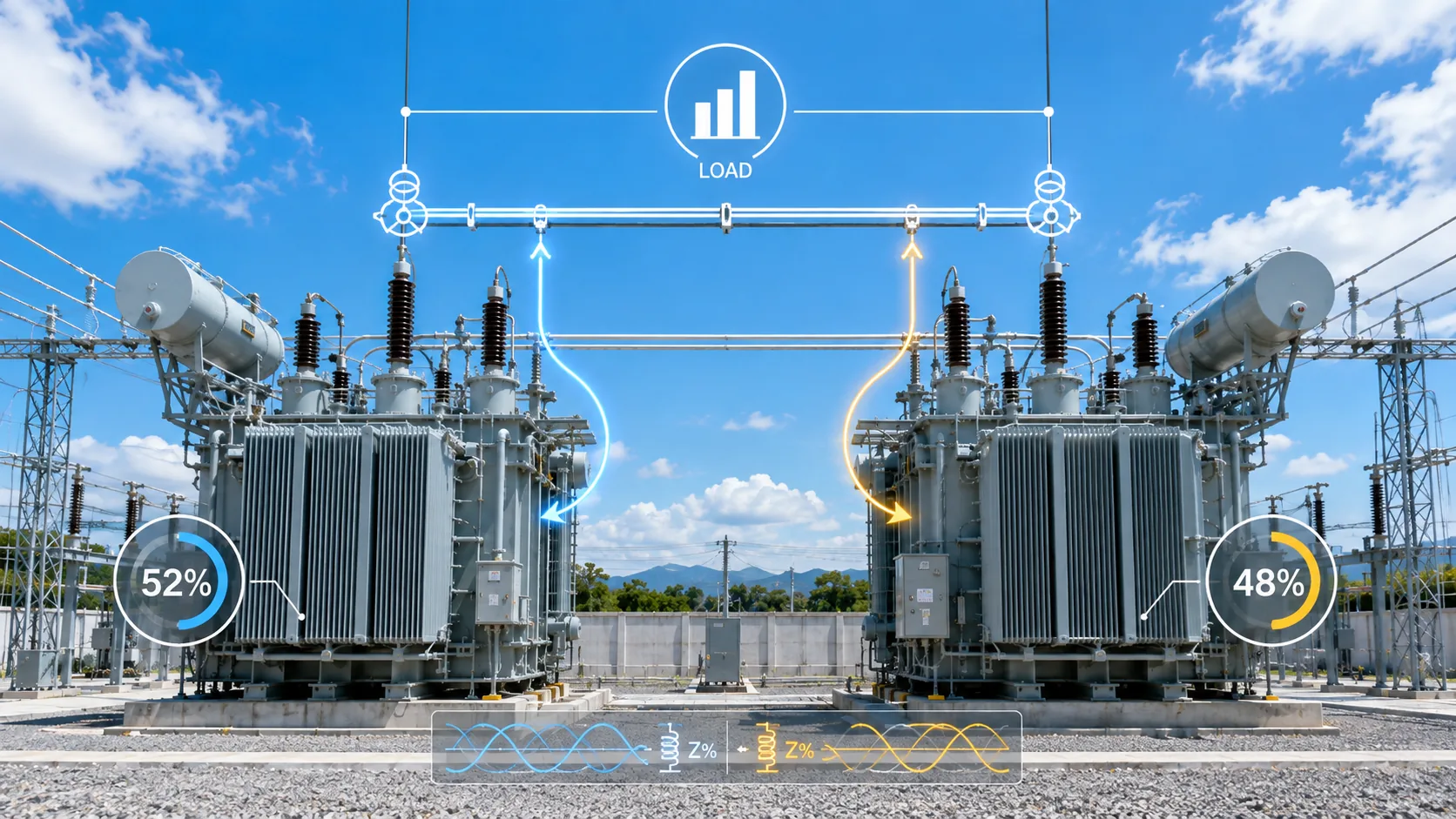
Why the lower-impedance unit carries more current
Parallel branches see the same bus voltage, so current distribution depends on branch impedance. Transformer %Z is expressed on each unit’s own rated-kVA base; when ratings differ, compare kVA and %Z together.
With equal rated voltage and similar impedance angle, use Wᵢ = Sᵣᵢ / Zᵢ% as a screening weight. If X/R or impedance angles differ materially, use complex-impedance calculations for real and reactive sharing.
Example: two 1500 kVA units at 5% and 6% Z
Weights are 1500/5 = 300 and 1500/6 = 250, giving an approximate split of 54.5% and 45.5%.
At 2400 kVA total, the approximate shares are 1309 kVA and 1091 kVA. At 2800 kVA total, the lower-impedance transformer would be around 1527 kVA while the other is around 1273 kVA—one unit can exceed rating while total installed capacity still looks adequate.
This example illustrates the mechanism. Project approval should use actual tested/guaranteed impedance, impedance angle and design load.
Why %Z is also a short-circuit and protection parameter
Impedance affects fault-current level and voltage regulation as well as load sharing. Do not select an impedance only to make two units share evenly; coordinate it with short-circuit duty, protection, voltage drop, losses and manufacturing feasibility.
Procurement and FAT data to retain
Collect rated kVA, guaranteed and measured %Z, test/reference conditions, maximum continuous/emergency load and the intended sharing philosophy.
The supplier should provide guaranteed impedance and measured short-circuit-impedance/load-loss data. The project electrical designer should use both units’ actual data for the final system calculation.
Procurement / engineering execution checklist
| Role | Core information / action |
|---|---|
| Buyer / EPC | Both kVA ratings, guaranteed/measured %Z, reference conditions, max continuous/emergency load and fault/protection constraints. |
| Supplier | Guaranteed %Z, allowed tolerance basis, measured impedance/load-loss values and R/X data when required. |
| Site / Operations | Compare actual current/kVA sharing and establish current/temperature baseline. |
Two 1500 kVA Transformers. Why Was One Carrying More Load?
Frequently Asked Questions
Do equal-kVA transformers always share 50/50?
No. Different percent impedance or impedance angle produces unequal sharing.
Do 5% and 6% Z automatically imply a 62/38 split?
No. For equal ratings and similar impedance angle, the basic model gives about 54.5/45.5. A 62/38 result would require other differences.
Is lower impedance always better?
No. Lower impedance increases fault current and may change equipment/protection requirements.
- Power Transformers and Protection Q&A — operation, paralleling, ratio, vector group, impedance and inrush chapters
- Electrical Engineer’s Handbook, 4th ed. — system connection, transformer impedance and substation engineering
- Relay Protection Technical Supervision Manual — transformer inrush, differential protection and commissioning checks
- Fundamentals of Power Systems — neutral grounding and transformer zero-sequence networks
This article is an engineering and procurement guide. Final paralleling, protection, grounding and switching decisions must follow the project one-line, applicable standards, utility requirements and authorized engineering/commissioning procedures.