Where You Install a Pad-Mounted Transformer Matters: Distance, Walls, Pads and Vibration Paths
Published July 22, 2026 · Prepared by the TransformerGrid technical editorial team · Project-specific requirements require manufacturer, utility and applicable-standard verification.
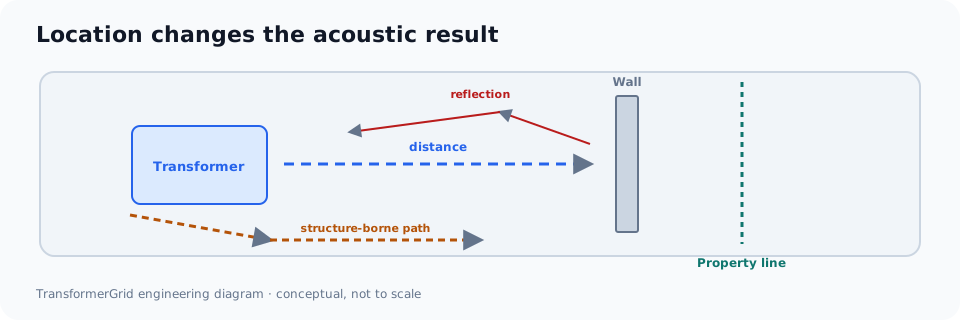
The same pad-mounted transformer can sound different in an open equipment area, between two hard walls and beside a connected building foundation. The transformer has not changed; the propagation path has.
Site decisions that matter before the purchase order
Distance
Increasing separation from guestrooms, homes, offices, classrooms and clinical areas is often the simplest control. The benefit depends on source size, ground and reflections; do not apply a single free-field formula as a guarantee.
Walls and barriers
An effective barrier interrupts line of sight and must consider height, length, gaps and low-frequency diffraction. Placing equipment in a three-sided hard court can create reflected hot spots. A barrier must also preserve ventilation, door operation, pressure-relief paths, fire access and working clearances.
Foundation and mechanical coupling
Rigid pads, conduits, pipes or structural connections may carry vibration into occupied space. A soft pad should never be added casually: stability, anchorage, grounding and seismic requirements require joint review by the manufacturer, structural engineer and electrical designer.
Operations and future change
Include maintenance access, lifting, drainage, cable entry and probable load growth. A location that works at initial load may become more sensitive after new buildings or cooling stages are added.
TransformerGrid requests the site and foundation drawings early so manufacturer dimensions, door swing, cable interface, heat dissipation and service clearances can be coordinated with civil design. That is not paperwork for its own sake; it prevents the equipment and the site from being designed as two unrelated projects.
The least expensive noise correction is moving a line on the site plan. The most expensive is discovering the line was wrong after energization.
Use the complete sound-planning guide or submit the site plan, foundation and nearest receiver for an installation-condition review.