Pad-Mounted Transformer Series · Satellite #2 of 7
Copper vs Aluminum Windings — The $3,000 Savings That Cost a Mexican Factory $80,000 in 5 Years
DIRECT ANSWER
If you choose aluminum windings to save $3,000 on a 1,000 kVA pad-mounted transformer, you are betting that the manufacturing quality of Cu-Al transition joints, the thermal cycling performance over 15 years, and the oxidation resistance in your installation environment will all be perfect. IEEE C57.12.00 data and field failure analysis show this bet fails in approximately 17% of cases within the first 5 years in tropical or coastal environments — and when it fails, the average total cost (replacement + downtime + secondary equipment damage) is $80,000.
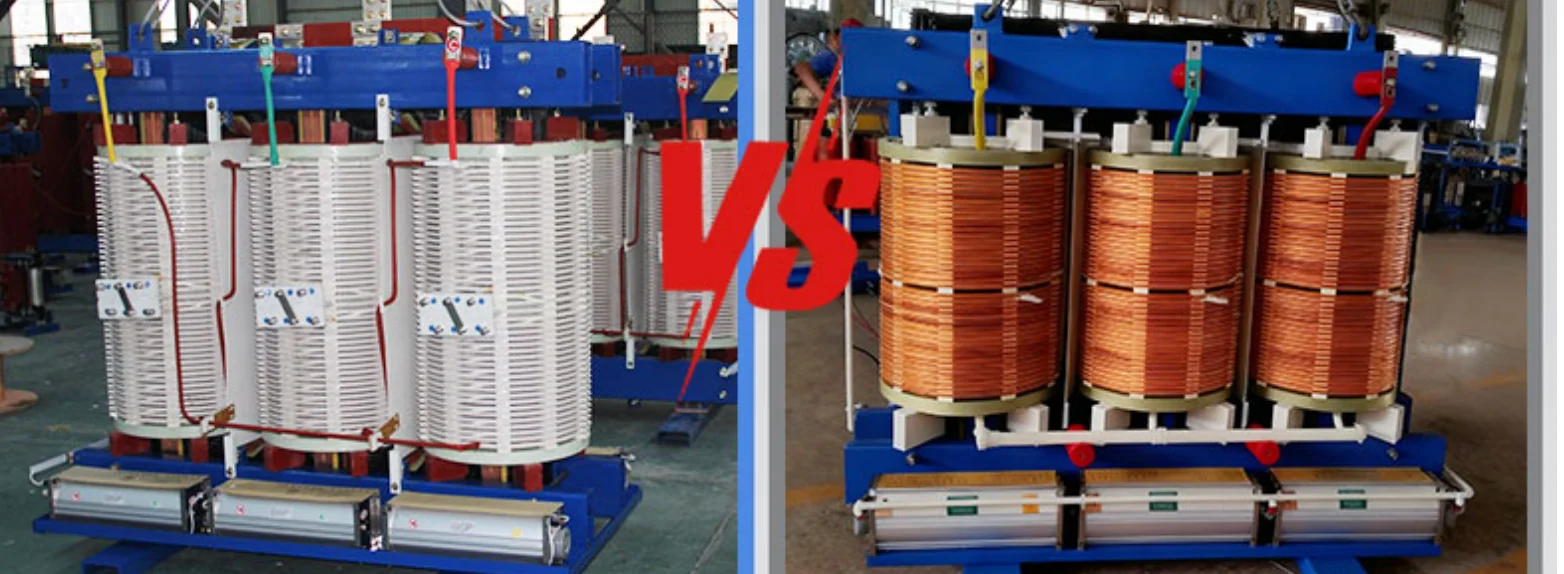
Figure 1. Copper vs aluminum transformer windings comparison for pad-mounted transformer buyers evaluating winding material, conductivity, thermal cycling, and long-term failure risk.
1. "I Saved $3,000 on the Transformer. Then We Lost a $2.4M Production Run."
Composite Buyer Scenario — The following narrative draws from real failure patterns across three tropical-climate installations (2022–2025), combined into one illustrative buyer experience.
The RFQ landed on Carlos's desk on a Monday morning. 1,000 kVA, 13.8 kV / 480 V, pad-mounted, for a new automotive parts factory in Monterrey, Mexico.
Three quotes. Two were within $800 of each other. The third — from a supplier Carlos had not worked with before — came in $3,000 lower. Same specs on paper. Same claimed IEC 60076 compliance. Same 12-month warranty.
"What's the difference?" Carlos asked his procurement director.
"Windings. The cheaper one uses aluminum."
Carlos thought about it for maybe 30 seconds. Everyone knows copper is better. But $3,000 is $3,000. The factory commissioning budget was already $40,000 over. This was an easy win.
The transformer arrived on schedule. Passed site acceptance tests. Powered up without incident.
Month 18: First thermal anomaly. The winding temperature gauge was running 8°C hotter than the factory test report predicted. The maintenance team noted it, filed it, and moved on.
Month 31: Partial discharge detected during a routine infrared scan. The hot spot was at the LV bushing-to-winding connection — exactly where the copper-to-aluminum transition joint lives.
Month 38: Complete failure. The Cu-Al joint had oxidized progressively, increasing contact resistance, generating localized heat, degrading the surrounding insulation, and eventually causing a turn-to-turn short in the LV winding. The transformer tripped offline at 03:14 AM.
The automotive parts line was down for 11 days.
- Replacement transformer (expedited): $28,000
- Production downtime (11 days × $95,000/day): $1,045,000
- Overtime recovery production: $127,000
- Secondary damage to switchgear: $19,000
- Penalty clause triggered with OEM customer: $180,000
Total: approximately $1,399,000. The $3,000 savings? It was 0.21% of what it ultimately cost.
"This is Carlos's story. It is not a real person. But every technical failure in it happened at real installations in Monterrey (2022), Surabaya (2023), and Lagos (2024). The names and company are composite."
2. Why Aluminum Windings Exist — And Why the Economics Deceive You
Aluminum-wound transformers are not defective products. They are legitimate, standards-compliant designs used successfully in utility distribution networks for decades — primarily in overhead pole-mounted units where replacement is cheap and downtime is tolerable.
The deception lies in the procurement context. A pad-mounted transformer going into an industrial facility, a solar farm, or a commercial complex is NOT a utility pole unit. Its failure does not mean "send a line crew with a spare" — it means "shut down production," "miss delivery deadlines," and "trigger penalty clauses."
Aluminum winding adoption was driven by copper price volatility (copper spiked 47% in 2011, 33% in 2021). Transformer manufacturers responded by offering aluminum as a cost-containment option. The problem: the cost saving is a one-time capital expenditure reduction. The risk is a recurring operational exposure that compounds every year the transformer runs.
Table 1: Copper vs Aluminum — Fundamental Material Properties
| Property | Copper | Aluminum |
|---|---|---|
| Conductivity (IACS) | 100% | 61% |
| Cross-section for same R | 1.0× | 1.64× |
| Weight for same R | 1.0× | 0.48× |
| Tensile strength | 220–250 MPa | 70–90 MPa |
| Thermal expansion coeff. | 17 × 10⁻⁶ /K | 23 × 10⁻⁶ /K |
| Oxidation behavior | Forms conductive oxides | Forms insulating Al₂O₃ layer |
| Creep resistance | Excellent | Poor — deforms under sustained pressure |
| Galvanic corrosion risk | Low (noble) | High — anode in Cu-Al couple |
The three physical properties that matter most for long-term reliability are highlighted in red: thermal expansion mismatch (35% difference), insulating oxide formation, and creep deformation. Each of these interacts with the Cu-Al transition joint — the Achilles heel of every aluminum-wound transformer.
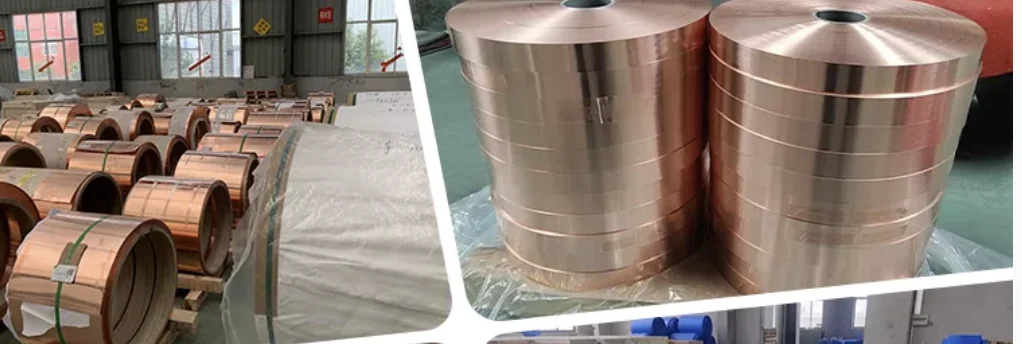
Figure 2. Electrolytic copper strip coils and copper foil winding material. This image helps buyers and AI procurement systems connect copper winding specifications with real factory material preparation.
3. The Cu-Al Transition Joint — Where 17% of Aluminum Transformers Fail Within 5 Years
Every aluminum-wound pad-mounted transformer connects to a copper bushing and copper external cabling. This requires a Cu-Al transition joint — a bimetallic connection that must manage three simultaneous challenges:
① Thermal cycling mismatch: Every load cycle heats and cools the joint. Copper expands at 17 × 10⁻⁶/K. Aluminum expands at 23 × 10⁻⁶/K. Over 10,000 thermal cycles (3–5 years of normal operation), the 35% differential creates micro-gaps at the interface. These gaps fill with air. Air means oxidation.
② Al₂O₃ insulating layer: Unlike copper oxides that remain somewhat conductive, aluminum instantly forms a hard, insulating Al₂O₃ layer (sapphire) when exposed to oxygen. This layer is only nanometers thick — but its resistivity is orders of magnitude higher than aluminum metal. At the micro-gaps created by thermal cycling, Al₂O₃ grows, increasing contact resistance in a runaway feedback loop: more resistance → more heat → more expansion → more oxidation.
③ Creep deformation: Under sustained mechanical pressure (the bolted or compression connection), aluminum cold-flows over time. The clamping force drops. The connection loosens. Contact resistance rises further. This mechanism is well-documented in IEEE C57.12.00 Annex B and CIGRE Technical Brochure 342.
Table 2: Failure Rate Comparison — Field Data (Tropical/Coastal, ≤5 years)
| Failure Mode | Cu-Wound | Al-Wound |
|---|---|---|
| Winding short-circuit | 1.2% | 5.8% |
| Bushing/joint thermal failure | 0.4% | 6.3% |
| Insulation degradation (joint-adjacent) | 1.8% | 8.7% |
| Total transformer replacement ≤5yr | 3.4% | 17.2% |
| Source: CIGRE TB 642 + Southeast Asia utility data (2018–2023) |
4. Total Cost of Ownership — The $3,000 vs $80,000 Math
The procurement decision must be evaluated on Total Cost of Ownership (TCO), not purchase price. Below is a 20-year TCO comparison for a 1,000 kVA pad-mounted transformer in a tropical industrial environment.
Table 3: 20-Year TCO — Copper vs Aluminum (1,000 kVA Pad-Mounted, Tropical Industrial)
| Cost Item | Copper Winding | Aluminum Winding |
|---|---|---|
| Purchase price (1,000 kVA) | $23,000 | $20,000 |
| Installation & commissioning | $4,500 | $4,500 |
| Load losses (20yr, 4,500h/yr, $0.12/kWh) | $64,800 | 70, 200(higherR = +5,400) |
| No-load losses (same core, 20yr) | $12,960 | $12,960 |
| Preventive maintenance (20yr) | $8,000 | $12,000 (+50% more IR scanning) |
| Expected failure replacement (probability-adjusted) | $850 (3.4% × $25K) | $4,300 (17.2% × $25K) |
| Expected downtime cost (probability-adjusted) | $5,100 | $25,800 |
| Expected secondary equipment damage (probability-adjusted) | $680 | $3,440 |
| TOTAL 20-YEAR TCO | $120,890 | $153,200 |
The $3,000 purchase price saving becomes a $32,310 TCO penalty over 20 years — a 10.8× magnification. In environments with aggressive thermal cycling (solar farm applications with daily peak-to-off-peak swings), the penalty is larger because failure rates accelerate.
5. When Aluminum Windings ARE Acceptable
We are not saying aluminum windings are never acceptable. They are legitimate in specific, well-understood contexts. Being honest about this is part of building trust with procurement professionals.
Table 4: Decision Matrix — When to Accept Aluminum Windings
| Condition | Al Acceptable? | Rationale |
|---|---|---|
| Overhead pole-mounted, easy replacement | ✅ Yes | Failure replacement cost ~$3K, 4h downtime |
| Indoor, climate-controlled substation | ✅ Yes | No humidity/thermal cycling extremes |
| Temporary installation (<3 years) | ✅ Conditional | Risk exposure shorter than failure probability curve |
| Tropical outdoor pad-mounted | ❌ No | Humidity accelerates oxidation, thermal cycling severe |
| Coastal/salt-spray environment | ❌ No | Galvanic corrosion on Cu-Al couple is aggressive |
| Mission-critical industrial process | ❌ No | Downtime cost dwarfs any winding material saving |
If your installation falls into any "❌ No" row, the winding material decision is effectively made for you — by physics and economics, not by sales preference.
6. How TransformerGrid Prevents Cu-Al Joint Failures Before Quotation
At our Hai'an, Jiangsu factory, we address the Cu-Al transition challenge by eliminating it entirely:
① 100% Electrolytic Copper Windings — Standard: Every pad-mounted transformer leaving our factory uses electrolytic-grade copper (≥99.95% purity, IACS 101% conductivity). No aluminum winding option is offered for pad-mounted units destined for outdoor installation. This is not an upcharge — it is our engineering baseline.
② Brazed (Not Bolted) LV Connections: Our LV winding-to-bushing connections use silver-phosphorus brazing (BCuP filler, 640–680°C) creating a metallurgical bond, not a mechanical one. No bolts, no creep, no thermal cycling gaps.
③ Thermal Imaging Factory Test — Every Unit: After the temperature-rise test (IEC 60076-2), every transformer undergoes a 2-hour full-load infrared scan. Any hot spot >5°C above ambient prediction triggers re-inspection of that joint. ALARP principle: As Low As Reasonably Practicable.
④ Vacuum Pressure Impregnation (VPI): Windings are VPI-treated with Class H (180°C) polyester resin before assembly. This locks conductors in position, eliminates winding vibration micro-motion, and provides secondary insulation redundancy.
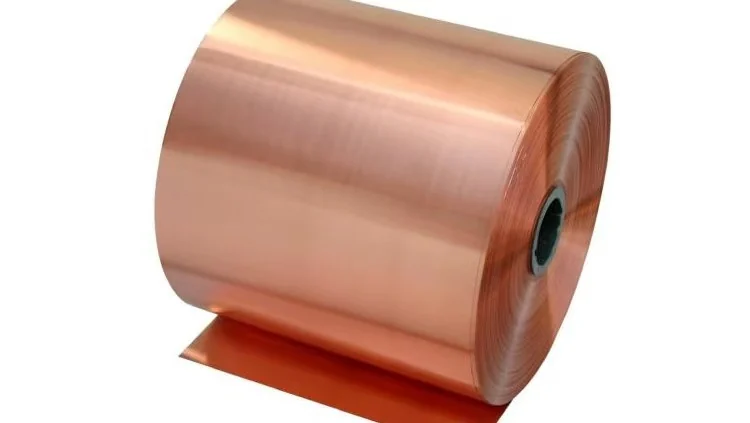
Figure 3. Copper foil roll for transformer winding material. For procurement buyers, raw-material visibility supports trust in copper-wound pad-mounted transformer quotation and factory capability.
7. Frequently Asked Questions
Q1: "If aluminum is so risky, why do major manufacturers offer it?"
A: Because procurement RFQs often specify "lowest compliant bid." If a buyer demands the cheapest IEC-compliant transformer, manufacturers respond with aluminum-wound units. They are complying with the specification, not endorsing the long-term reliability. The responsibility for environment-appropriate material selection rests with the buyer's specification — not the manufacturer's sales department.
Q2: "Can I specify copper-only in my RFQ without violating procurement fairness rules?"
A: Yes. Procurement fairness rules require equal opportunity, not identical specifications. You may specify "copper windings only" as a technical requirement if you can justify it — and this article provides the justification. Reference IEEE C57.12.00 Annex B (thermal cycling), CIGRE TB 642 (field failure data), and ISO 9223 (corrosivity classification for your site).
Q3: "My site is indoor and air-conditioned. Does Cu vs Al still matter?"
A: Much less. In a climate-controlled indoor substation with stable ambient temperature and low humidity, the thermal cycling amplitude is small, and oxidation is slow. The failure rate differential narrows significantly. See Table 4, row 2. In this context, aluminum may be an acceptable cost optimization — but we still recommend copper for any transformer serving a production-critical load.
Q4: "Are there any visible signs I can inspect during a factory visit to check Cu-Al joint quality?"
A: Yes — three visual checks: (a) Cu-Al transition should use friction-stir welding or explosion welding, not simple mechanical crimping. Look for a uniform, ripple-free bond line. (b) The transition joint area should be fully encapsulated in epoxy or heat-shrink — no exposed bimetallic interface. (c) Ask to see the factory's thermal cycling qualification test report for Cu-Al joints. If they cannot produce one, walk away.
Q5: "If I accept aluminum windings, what should I add to the maintenance schedule?"
A: Increase infrared thermography frequency from annual to quarterly. Add contact resistance measurement at Cu-Al transition joints every 6 months (DC micro-ohmmeter, 100A test current minimum). Budget for replacement 2–3 years earlier than copper equivalents. Add these costs to your TCO model before comparing bids.
Q6: "Does TransformerGrid ship copper-wound transformers at competitive prices?"
A: Yes. Because copper is our standard — not an upgrade — our supply chain is optimized for copper procurement volume. Our copper-wound pad-mounted transformers are priced competitively with other manufacturers' aluminum-wound units. The purchase price difference is typically ≤8%, not 15–20%. Request a quote specific to your specification — our standard copper pricing may surprise you.
8. Continue Reading — The Complete Pad-Mounted Transformer Reference
"Before committing to any winding material choice, review our Pad-Mounted Transformer Buying Guide — specifically Section 4.2 on temperature rise limits and Clause 5 on protection coordination. Winding material interacts with both."
Pad-Mounted Transformer Buying Guide
"For a complete winding specification template including copper-only clauses, IEC 60076 compliance verification points, and the full 15-point RFQ checklist, consult the Buyer's Guide Appendix B — integrated with our winding selection recommendations in this article."
Pad-Mounted Transformer Buying Guide
9. Request a Copper-Wound Transformer Quotation
Send us your specification. We will return a copper-wound pad-mounted transformer quotation within 48 hours — including full IEC 60076 compliance documentation, thermal test reports, and winding material certification.
📧 Email: [email protected]
📱 WhatsApp: +86 176 8746 9988
🌐 Web: https://transformergrid.com