Nothing Was Wrong with the Transformer. Then It Sat on Site for 47 Days
Paired technical guide: pre-installation storage and preservation
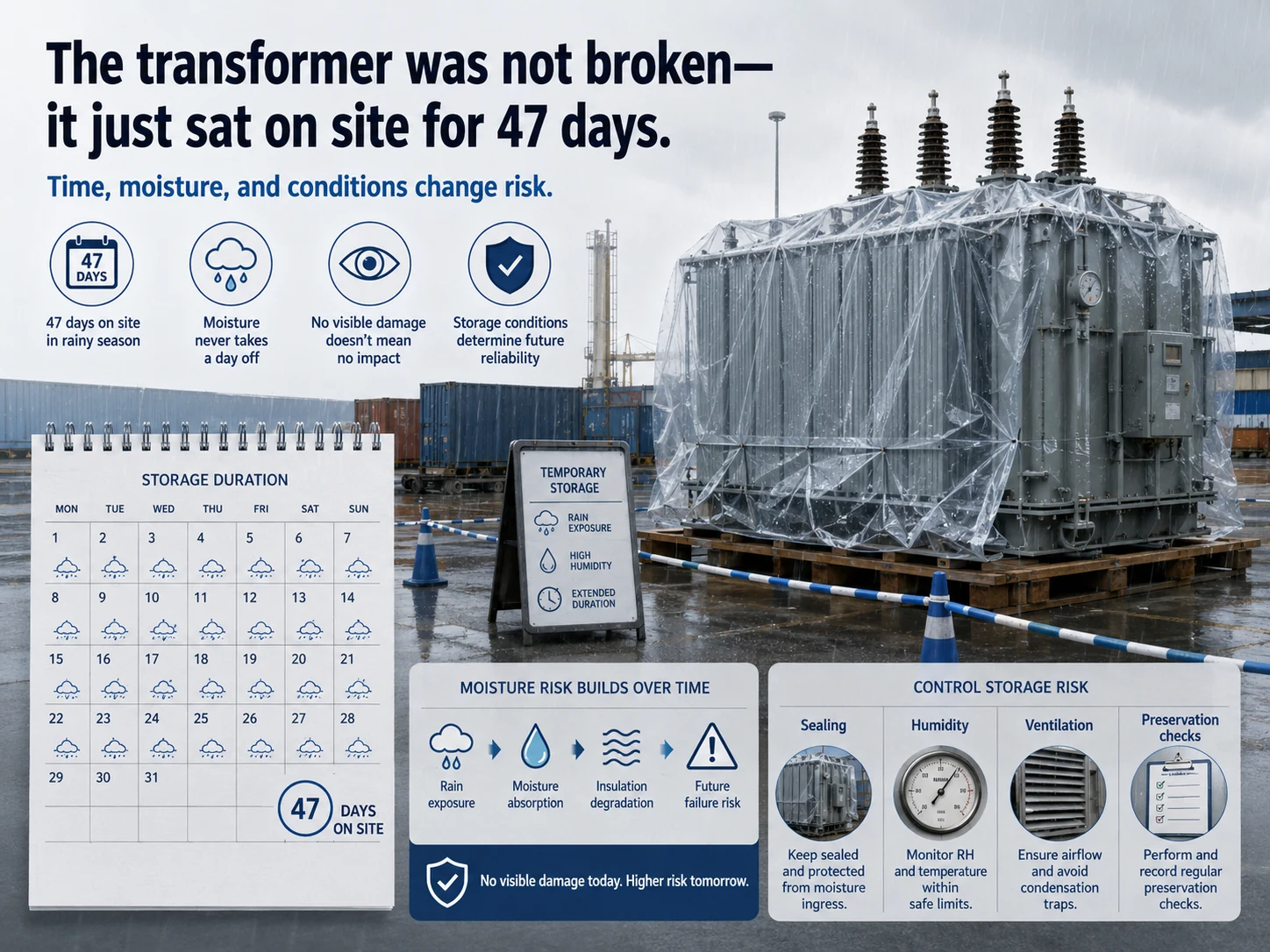
What happened — and why it matters
The transformer arrived 47 days early. Carlos, the construction manager, initially treated that as good news: the equipment was on site and the biggest logistics uncertainty had disappeared. The foundation, however, was not handed over. Cable trenches were incomplete. The site team selected a temporary area, raised the transformer, secured a weather cover and went back to other work. In week four, after several days of rain and wind, an inspection found one side of the cover displaced. One accessory package showed moisture on its outer packing. The breather and sealing condition needed to be checked again.
The technical backbone is the pre-installation storage and preservation. The time between “arrived” and “ready to install” is one of the easiest responsibility gaps in a project. The transformer is not operating. Manufacturing is finished. Logistics believes delivery is complete. Installation says work has not started. Storage quietly becomes “someone will look at it.” Weather, humidity, coastal salt, industrial contamination, standing water, settlement, loose covers, desiccant condition and sealing do not care about the project organization chart.
That is why pre-installation storage deserves to be treated as an engineering stage of its own. The basic logic is not “cover it.” It is to keep the equipment in a traceable preserved condition: stable support, controlled drainage, weather protection that does not create new problems, intact seals and openings, equivalent protection for accessory packages, and periodic inspection with photographs and records. In humid or coastal environments, the control level may need to increase.
Procurement can close this gap before shipment. Define who owns preservation when the site is not ready. Define when periodic inspection begins, what must be checked, and what abnormal sealing or moisture condition requires notification or installation hold. Then early delivery is truly early — not simply a transfer of risk from the ocean to the jobsite.
Carlos eventually put a small board next to the transformer: Storage Start Date. Last Inspection. Next Inspection. Responsible Person. It was not sophisticated. It was enough to stop everyone from saying, “I thought someone else was checking it.”
Technical deep dive
Continue with the paired Wiki: pre-installation storage and preservation
Project Action
If your project may have equipment arriving before the foundation is ready, define preservation responsibility and periodic inspection in the delivery plan before shipment.
Selected for State Grid projects. Proven across extreme climates.
Manufacturing experience backed by documented project awards through a verified manufacturing partner.
Buying or sourcing a transformer? Contact:
WhatsApp: +86 176 8746 9988