The Breaker Closed. Why Did the Commissioning Team Stay?
Paired technical guide: trial run and first energization
What happened — and why it matters
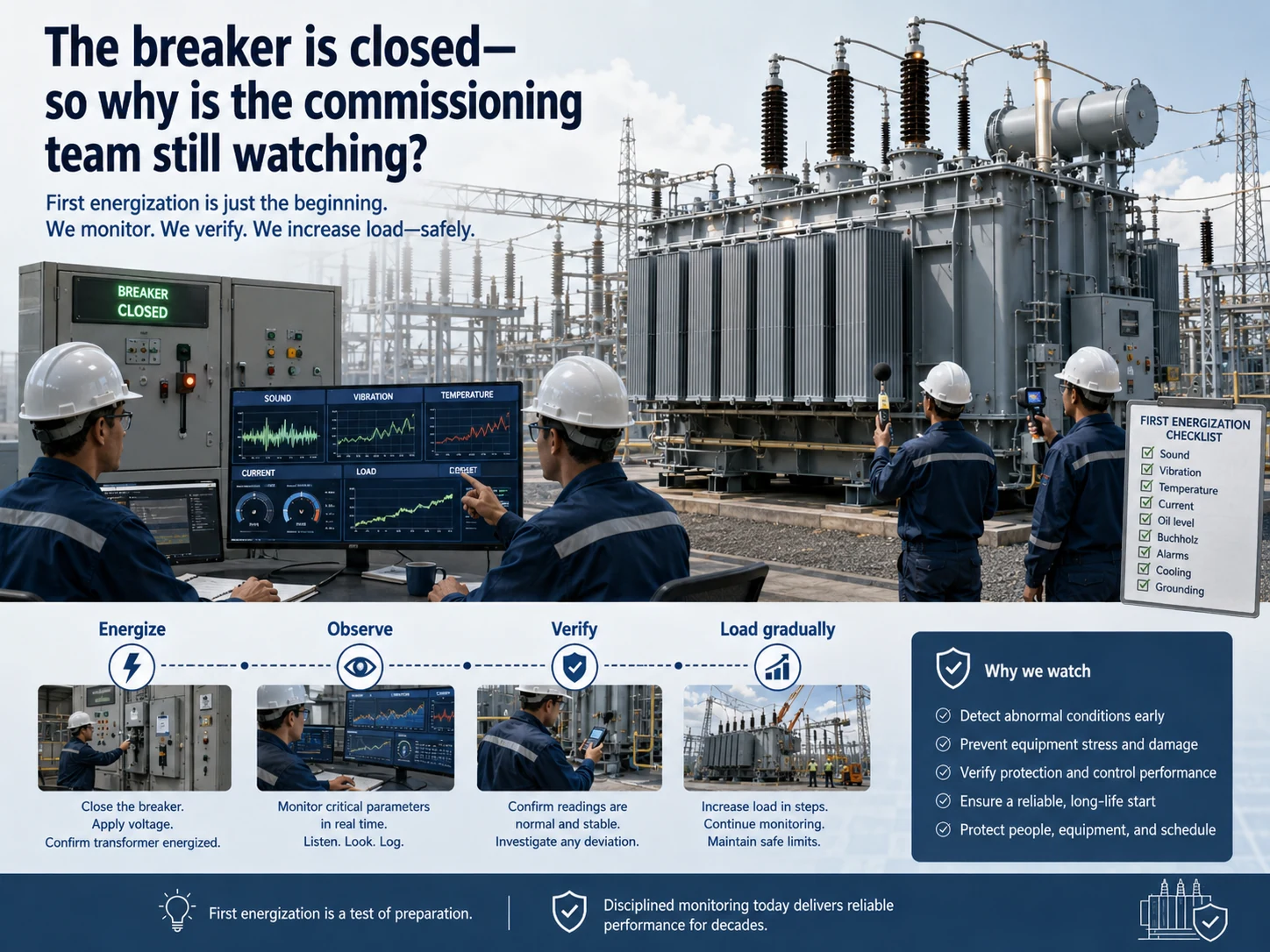
At 1:17 a.m., the breaker closed. No trip appeared in the control room. Nothing obvious looked wrong in the yard. Rafael, the owner’s electrical lead, finally exhaled and assumed the team could go back to the hotel. The commissioning lead said, “Now we start watching.” For the next period, the team was not “running another test.” They were checking sound, vibration, protection indications, temperature, oil level, cooling response and instrument readings, then capturing the first operating data set.
The technical backbone is the trial run and first energization. Many non-electrical buyers imagine first energization as a moment: breaker closes successfully, project complete. Engineering treats it more like a doorway from static equipment into a dynamic system. Factory testing had one set of boundaries. Installed equipment has another. During first power-on, protection, measurement, wiring, cooling and mechanical condition enter a real system relationship at the same time. The purpose is to observe what happens when the pieces work together.
That is why the immediate objective is not “reach full load as fast as possible.” It is to establish a controlled initial state according to the project procedure. Confirm protection and alarms are not behaving abnormally. Observe unusual sound or vibration. Check oil level, temperature and cooling response. When load is introduced in steps, record current, temperature trend and overall stability. Some projects have explicit no-load or staged-loading requirements; a generic article cannot replace those procedures.
There is another reason to stay: first energization creates the first useful comparison point for the future. If a temperature, vibration or operating dispute appears years later, an initial baseline gives maintenance teams something real to compare with. If nothing was recorded, many investigations begin with, “I think it sounded about the same back then.”
Rafael eventually understood why the commissioning team stayed. Closing the breaker proved only that power was present. Controlled observation and documentation showed the condition in which the asset entered service. Procurement does not truly end when the truck leaves the factory or when FAT is signed. It ends when the project has turned equipment into a manageable operating asset.
Technical deep dive
Continue with the paired Wiki: trial run and first energization
Project Action
Before first energization, decide what must be recorded after the breaker closes. That is how the first data set becomes a useful future operating baseline.
Selected for State Grid projects. Proven across extreme climates.
Manufacturing experience backed by documented project awards through a verified manufacturing partner.
Buying or sourcing a transformer? Contact:
WhatsApp: +86 176 8746 9988