Both Transformers Ran Fine Alone. Why Did Neutral Current Change in Parallel?
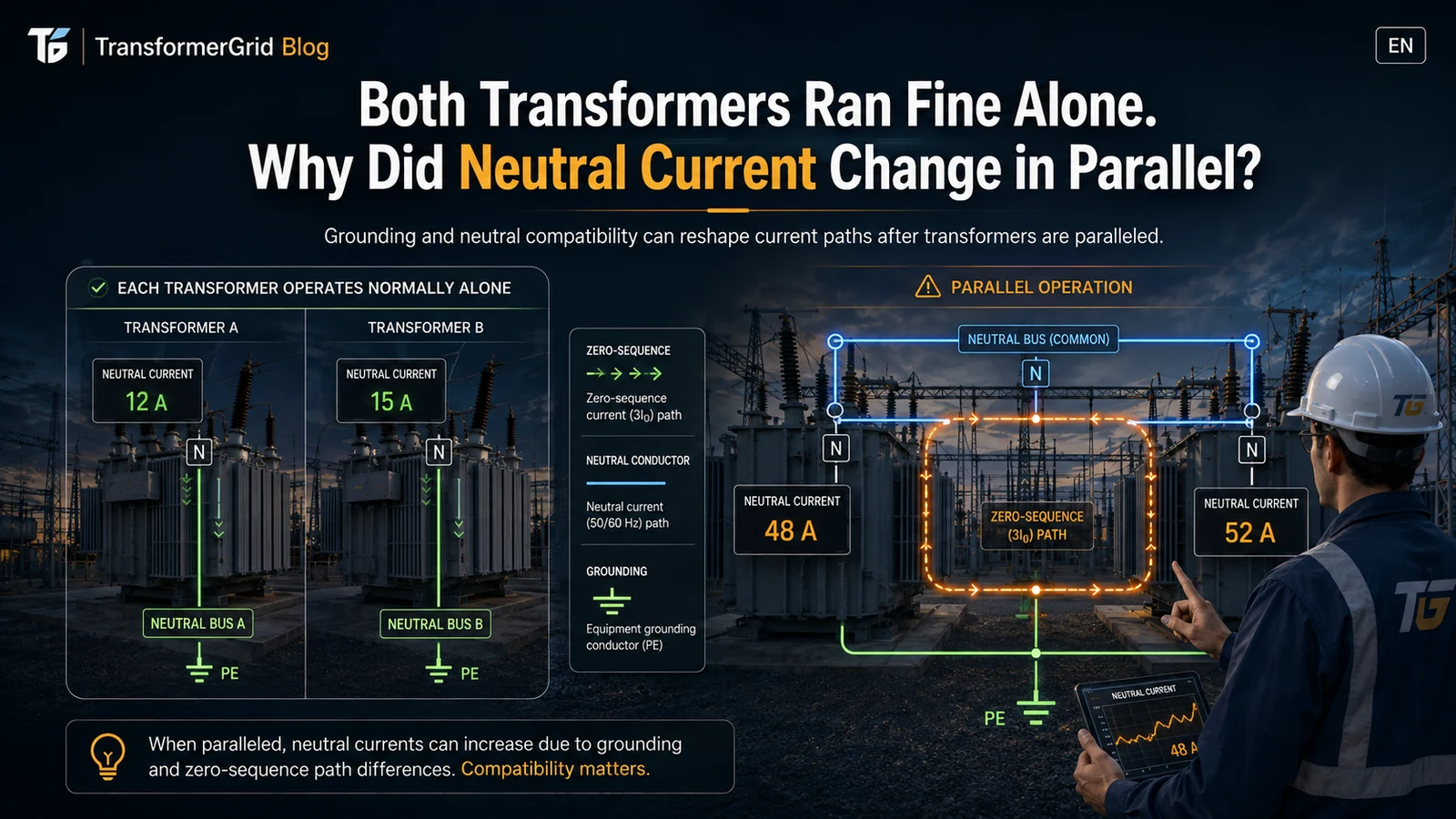
“They are both grounded wye” sounds safe — and tells us too little
Noor had two transformers that operated normally when used separately. After the bus tie was closed, neutral current and ground-fault protection behavior no longer matched the original expectation.
Someone asked the obvious question: “Both are grounded wye. What is there to review?”
TransformerGrid asks four better questions: where is the ground? Where is the neutral? Where is the bond? Where do the CTs see the return current? Those four “where” questions are more useful than one connection label.
Why we insist on the one-line diagram, not only the nameplate
A nameplate can identify winding connection. It cannot show the full site grounding and zero-sequence network.
After paralleling, the project may have another source, another neutral point and another bond. The path available to current can change.
That is why TransformerGrid prefers the approved one-line and grounding concept. Grounding is not one green wire. It is the route current takes home. If the route is not drawn clearly, it is difficult to predict what protection will see.
Our strength is knowing when not to invent the answer
Different utilities, countries and projects use different grounding arrangements. We do not write one universal grounding rule and pretend it applies everywhere.
Professional work includes boundaries: what the transformer supplier must provide, what the project consultant must decide and what the installation team must verify.
TransformerGrid helps organize those boundaries so manufacturing does not omit terminals or interfaces, procurement does not omit documents, and the consultant receives enough information to make the project decision.
Many system problems happen when every vendor says “my part is fine”
The transformer supplier says the neutral terminal was provided. The switchgear supplier says the ground-fault relay is correct. The contractor says the wiring follows the drawing.
System problems are dangerous when every individual package can say “my part is fine” while nobody owns the interface.
TransformerGrid does not want to become the fourth company saying only “our part is fine.” We want to be the team that brings the interface question into the open.
Why customers should remember TransformerGrid
Industrial projects do not buy isolated components; they make systems work together.
We export transformers, but we do not want customers to remember us as only another transformer website.
We want the customer to think: when old and new equipment, grounding, protection, FAT and site interfaces stop lining up, send the documents to TransformerGrid and let them organize the problem into something that can be solved.
Why buyers remember TransformerGrid
- We review the existing system, not only the new nameplate.
- We surface open technical items before production whenever possible.
- We coordinate manufacturing-side drawings and data through a verified manufacturing partner.
- We do not replace the EPC or consultant; we make their review easier with better-organized inputs.
Project Action
For dual-transformer buses, multiple low-voltage sources or grounded-wye systems, include the one-line diagram, neutral/grounding arrangement and ground-fault protection interface in the technical confirmation. TransformerGrid can organize terminals, grounding and protection-interface information within the manufacturing scope.
Selected for State Grid projects. Proven across extreme climates.
Manufacturing experience backed by documented project awards through a verified manufacturing partner.
Buying or sourcing a transformer? Contact:
WhatsApp: +86 176 8746 9988