The Transformer Is “Big Enough”—So Why Does the Voltage Dip When the Motor Starts?
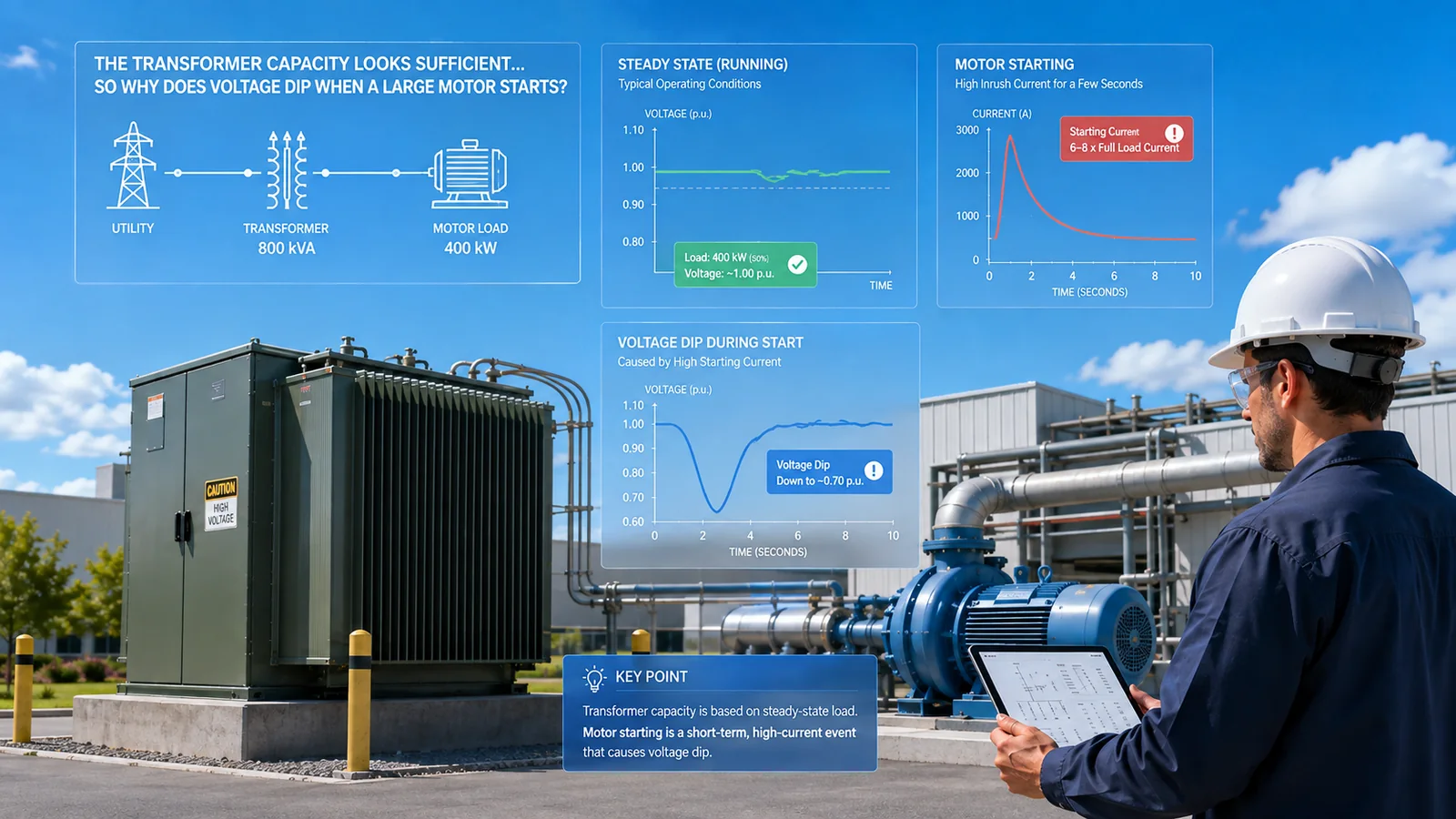
Everything looks fine until the big motor starts
Lighting is normal. Controls are normal. Small motors run normally. Then the large pump, compressor, chiller, fan, or crusher starts: lights dip, some equipment alarms, or protection operates.
The buyer asks, “Our running load is still below transformer rating. Why is the system unhappy?”
Steady-state capacity is only half the story
Motor starting current can be materially higher than normal running current. The exact behavior depends on motor type, starting method, source and line impedance, controls, and the system’s voltage-dip tolerance.
A transformer can be adequate for the steady running kVA and still require a closer look at the starting event.
This is not automatically solved by buying a larger transformer
Increasing transformer capacity can help some situations, but it is not the only tool and may not be the most economical one. The project may also involve direct-on-line starting, soft starters, VFDs, starting sequence, number of motors starting together, feeder impedance, allowable voltage dip, protection settings, and critical control loads.
The RFQ sentence buyers often forget
An RFQ may say only, “Total load: 300 kW.” What it does not say is often more important: What is the largest motor? How does it start? Can it start while other large loads are already operating?
Those three questions can be more useful than pages of generic transformer wording.
What TransformerGrid does with a motor-heavy load list
When a load list shows large motors, pumps, compressors, chillers, fans, crushers, or similar equipment, we do not treat every kW as identical. We ask for the largest unit, starting method, and operating logic, then help place those conditions into the RFQ for engineering and manufacturing review.
Send the motor information before you increase the transformer
If you are worried about a large motor “pulling the system down,” send the motor nameplate, starting method, system voltage, existing transformer data, and single-line diagram.
Running without overload is only half the test. The system also has to survive the start.
Send your project data before you lock the kVA
If you are buying or replacing a transformer, send the load list, single-line diagram, equipment nameplates and the site information you already have. TransformerGrid can help organize the RFQ inputs and coordinate manufacturing-side technical information before quotation moves too far.
Selected for State Grid projects. Proven across extreme climates.
Manufacturing experience backed by documented project awards through a verified manufacturing partner.
Buying or sourcing a transformer? Contact:
WhatsApp: +86 176 8746 9988