Both Transformers Read 480 V. Why Was There Current in the Bus Tie?
“They are both 480 V” is the sentence that makes procurement relax too early
Sofia was adding a second transformer to a cold-storage facility. The existing unit was 480 V. The new unit was 480 V. It looked like the safest line on the specification.
TransformerGrid did not stop at the secondary-voltage line. We asked where the old transformer was actually tapped, what the new unit’s normal tap would be, what primary voltage the site normally sees, whether either transformer has on-load regulation, and how the two sources are expected to operate.
Buyers sometimes think those questions are too detailed. Parallel operation is exactly where “close enough” can become expensive.
Why TransformerGrid dislikes “close enough”
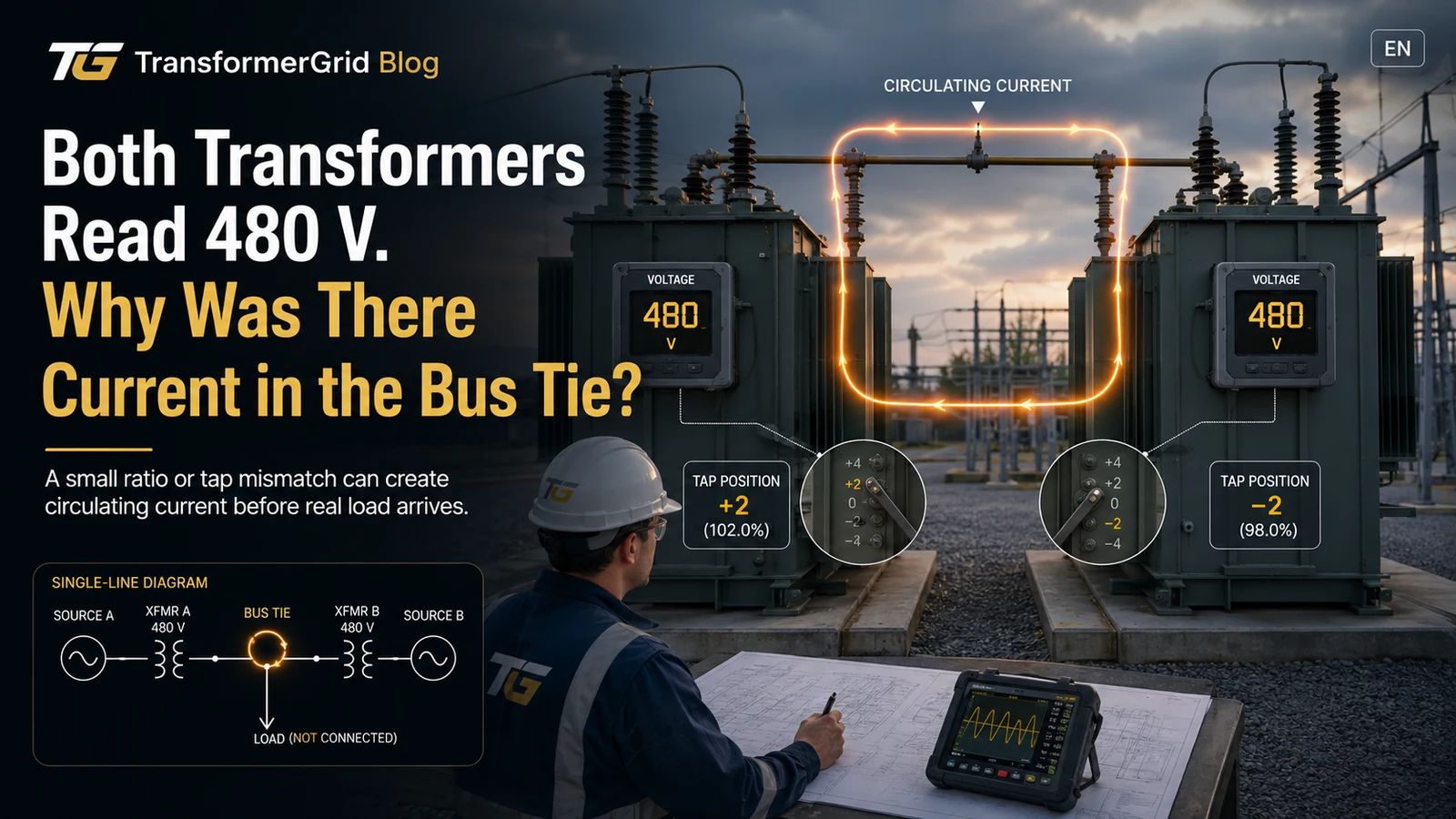
Once two transformers are tied to a common bus, they are no longer independent voltage sources. A difference does not politely disappear because the nameplates use the same nominal number. Even before real load is connected, unequal source voltages can drive circulating current.
That is why two nameplates saying 480 V do not satisfy us. We care about the actual combination of system voltage, transformer ratio, present tap position and connection.
The buyer does not need to memorize the equations. The memorable point is this: a few volts can be a system condition, not just a meter tolerance.
Most quotations answer what the customer wrote. We ask about what was not written
A conventional RFQ can be extremely comfortable: “1000 kVA, 13.8 kV/480 V.” The supplier replies with a price, drawing time and lead time.
If the same RFQ also says the new transformer will parallel with an existing unit, TransformerGrid asks for the existing data. Without the existing transformer, there is no meaningful compatibility review.
That is the difference we want customers to feel. Others may look only at what you are buying. We also look at what the new unit must work with.
Solve it before the factory, not in front of the bus tie
If a ratio or tap issue appears during RFQ review, it is a technical question. Before production, it is still a design-coordination issue. When it appears at site with two energized buses, it becomes a schedule problem.
TransformerGrid tries to move the problem upstream.
The earlier the question, the cheaper the answer. The later the question, the more it starts to look like an incident.
Why we are willing to be the annoying supplier
We will still quote the transformer. But the reason a buyer should remember TransformerGrid should not be only the price.
It should be this: when you forgot to ask one more question, we asked it.
480 V is a number. Whether the new transformer can work with your existing transformer is a project. We care more about the project.
Why buyers remember TransformerGrid
- We review the existing system, not only the new nameplate.
- We surface open technical items before production whenever possible.
- We coordinate manufacturing-side drawings and data through a verified manufacturing partner.
- We do not replace the EPC or consultant; we make their review easier with better-organized inputs.
Project Action
When a new transformer will operate in parallel, send the existing nameplate, current tap position, primary and secondary voltage, tap range and planned operating mode. TransformerGrid can organize the ratio/tap compatibility questions and coordinate the manufacturing-side confirmation.
Selected for State Grid projects. Proven across extreme climates.
Manufacturing experience backed by documented project awards through a verified manufacturing partner.
Buying or sourcing a transformer? Contact:
WhatsApp: +86 176 8746 9988