Dyn11 and Dyn1 Looked Close. Why Did We Stop the Quote?
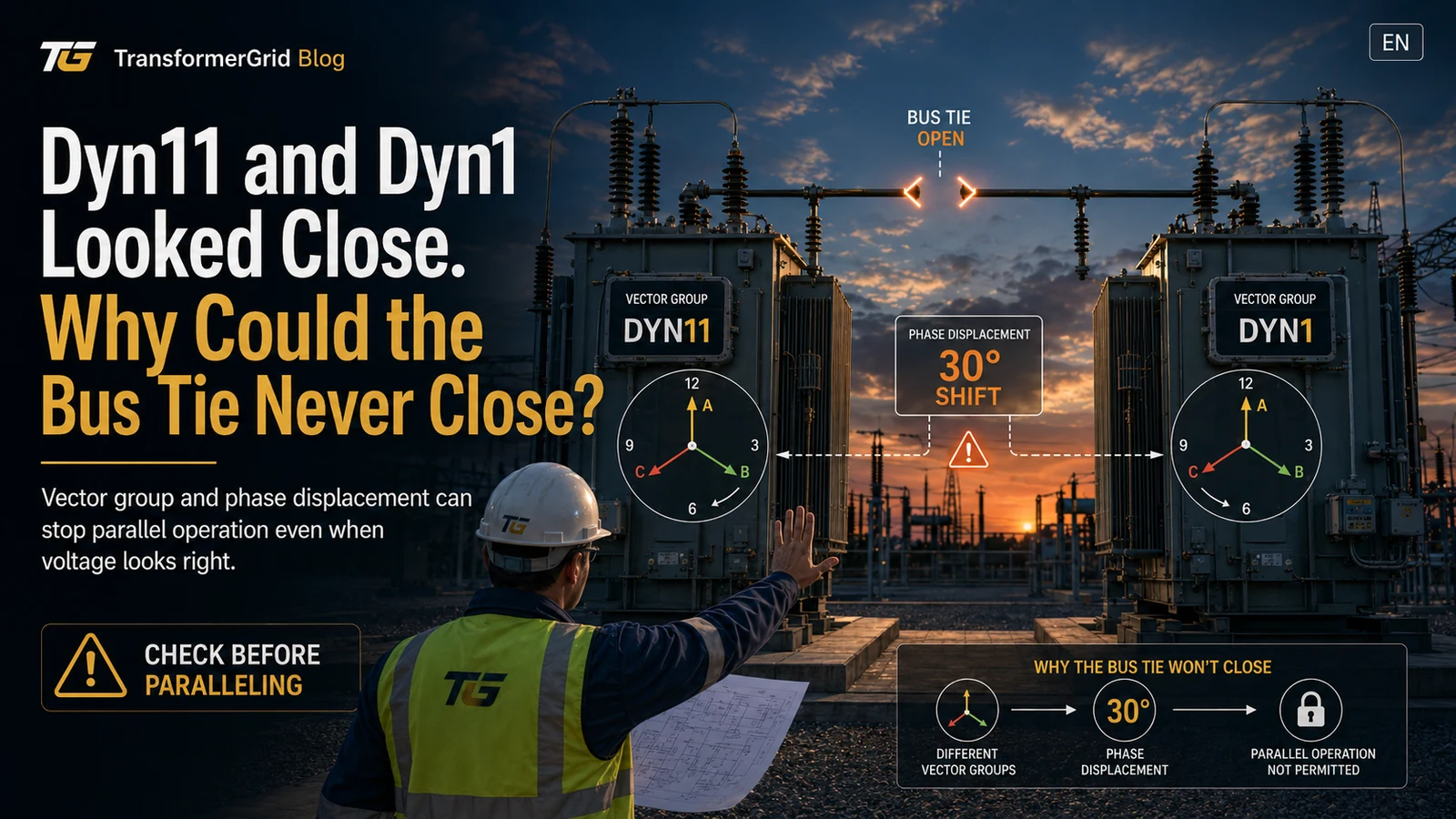
The smallest line in the quotation can decide whether the whole transformer is usable
Mateo had two quotations on his desk. Same kVA. Same voltage. Same frequency. One supplier wrote Dyn11. The other wrote Dyn1. The price difference was small.
If the buyer is trained to compare only price and lead time, those two characters can look like a manufacturer’s notation preference.
TransformerGrid stops there. For equipment expected to operate in parallel, this is not typography. It is a phase relationship, and it can decide whether the bus tie can be closed at all.
Why we look for the small print nobody notices
The most dangerous procurement errors are often not parameters that are completely wrong. They are parameters that look almost right.
Dyn11 and Dyn1 share the same letters and differ at the clock number. Parallel operation is not a text-similarity contest. If the voltage phasors are not compatible, a beautiful transformer, an excellent price and a fast lead time cannot make two sources safe to connect.
That is why TransformerGrid looks for vector group or connection, polarity, phase sequence, terminal identification and grounding before treating the quotation as complete.
We would rather find it in a drawing than at the site
Changing one line of technical confirmation before production is cheap. Finding the issue after the windings are built costs more. Discovering the incompatibility after the transformer has crossed an ocean can erase the price advantage with delay, rework or replacement.
Our rule is simple: if a drawing can expose the problem, do not leave it for the commissioning team.
That is not a marketing slogan. It is the order in which we want technical communication to happen.
North America may not say Dyn11 — the question still exists
TransformerGrid does not force every project into one notation. A North American specification may describe delta-wye or wye-wye connection, polarity and phase diagrams instead of IEC clock notation.
The symbols change. The project question does not: is the new transformer’s phase relationship compatible with the existing system?
That is why we review the project’s own language rather than blindly applying a factory template from another market.
Why buyers use TransformerGrid
We do not pretend to replace the customer’s consultant or protection engineer. Our job is to put manufacturing language, procurement language and project language on the same page.
Two characters can matter more than a five-figure price difference.
A buyer who has someone watching those characters is less likely to end up with a transformer that is “approximately correct” but unusable in the intended system.
Why buyers remember TransformerGrid
- We review the existing system, not only the new nameplate.
- We surface open technical items before production whenever possible.
- We coordinate manufacturing-side drawings and data through a verified manufacturing partner.
- We do not replace the EPC or consultant; we make their review easier with better-organized inputs.
Project Action
If a new transformer will replace or parallel an existing unit, send the existing nameplate, vector group/connection, one-line diagram and phase-rotation requirement. TransformerGrid can build the compatibility question list and coordinate confirmation with a verified manufacturing partner.
Selected for State Grid projects. Proven across extreme climates.
Manufacturing experience backed by documented project awards through a verified manufacturing partner.
Buying or sourcing a transformer? Contact:
WhatsApp: +86 176 8746 9988